


Credit:
NASA
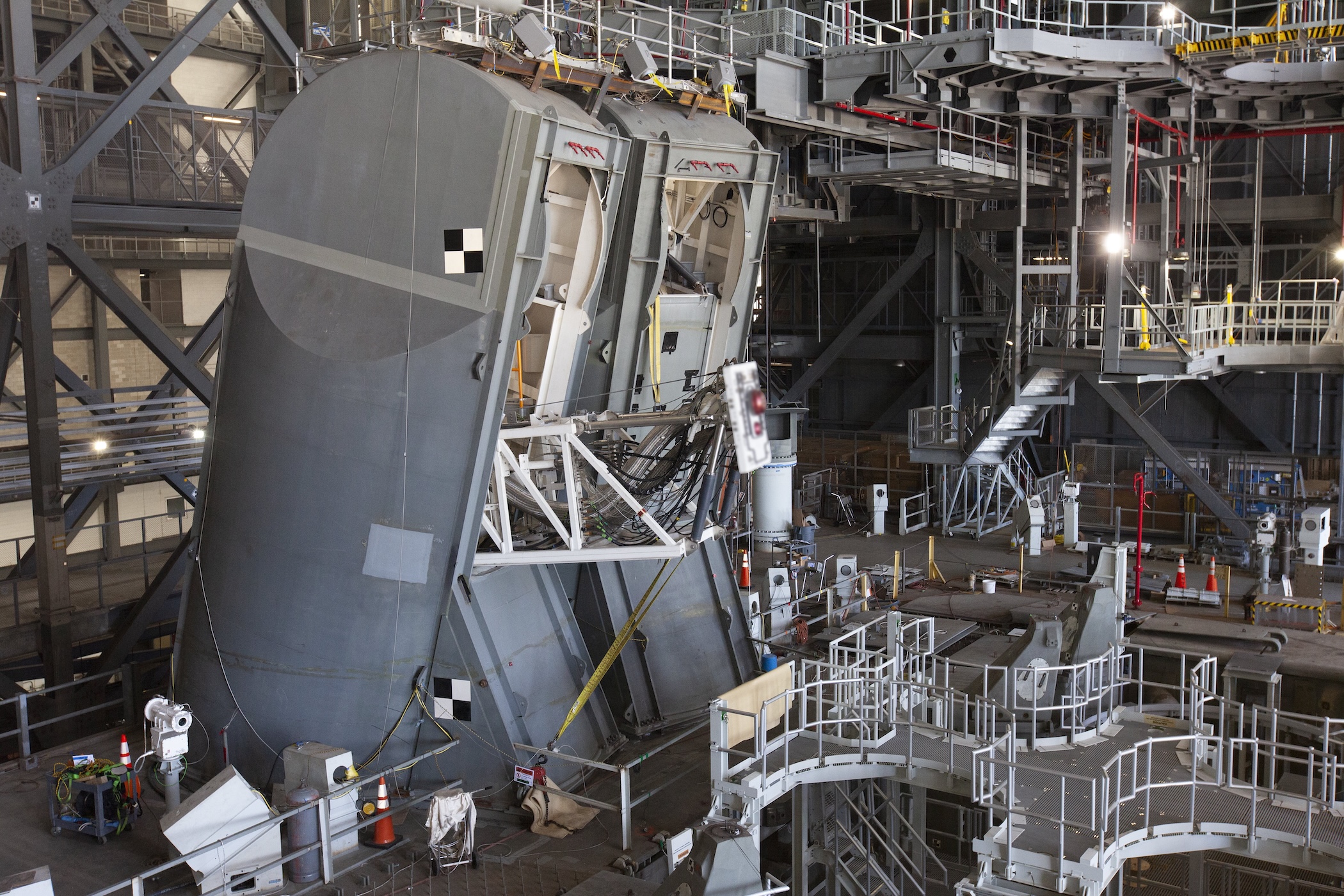
This photo taken in 2019 shows the liquid hydrogen Tail Service Mast Umbilical undergoing tests inside the Vehicle Assembly Building. The connector plate is visible at the end of the arm in the center of the photo.
Credit:
NASA
“ Attempts to resolve the issue involved stopping the flow of liquid hydrogen into the core stage, allowing the interface to warm up for the seals to reseat, and adjusting the flow of the propellant,” NASA said in a statement.
NASA appeared to get past the problem Monday evening and fully loaded the 322-foot-tall (98-meter) rocket with more than 750,000 gallons of propellant.
With fueling complete, managers sent a closeout crew to the launch pad around 6:00 pm EST (23:00 UTC) to close the hatch to the Orion spacecraft sitting atop the SLS rocket. The closeout team will help the Artemis II astronauts into the Orion capsule on launch day, but the crew was not part of the practice countdown Monday night.
The closeout crew took longer than anticipated to close and secure the hatch to the Orion spacecraft. A valve associated with Orion’s hatch pressurization inadvertently vented, according to NASA, requiring the closeout crew to retorque the valve. The launch team dealt with several other glitches, including audio dropouts on ground communication loops and camera problems believed to be caused by recent cold weather in Central Florida.
Finally, with the closeout crew a safe distance away from the rocket, the launch team gave approval to begin the final 10 minutes of the countdown shortly after midnight Tuesday. The objective was to stop the countdown clock 33 seconds prior to launch, about the same time the rocket would take control of the countdown during a real launch attempt.
Instead, the clock stopped at T-minus 5 minutes and 15 seconds. NASA said the countdown terminated “due to a spike in the liquid hydrogen leak rate.” The countdown ended before the rocket switched to internal power and fully pressurized its four propellant tanks. The test also concluded before the rocket activated its auxiliary power units to run the core stage’s four main engines through a preflight steering check, all milestones engineers hoped to cross off their checklist.
Launch controllers began work to drain the SLS rocket’s propellant tanks after calling an end to the countdown. With the test incomplete, NASA managers quickly decided to hold off on launching the Artemis II mission to allow time for ground teams to “fully review data from the test, mitigate each issue, and return to testing ahead of setting an official target launch date.”
Officials did not immediately announce when they might be ready for a second Wet Dress Rehearsal, or whether they plan to roll the rocket back to its assembly building for repairs. NASA managers plan to hold a press briefing Tuesday to discuss the results of the test in more detail.