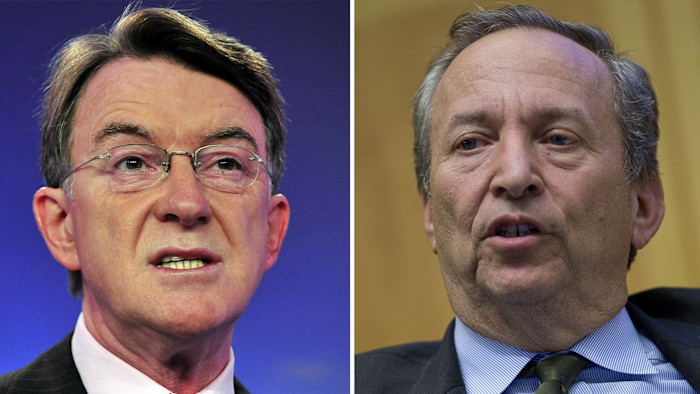
Lord Peter Mandelson lobbied the US government on behalf of Jeffrey Epstein and Jes Staley in 2010 when he was a UK minister, using their talking points in conversations with an American official about financial-crisis reforms.



Mandelson agreed with Epstein that he would urge Larry Summers, then director of Barack Obama’s National Economic Council, to meet JPMorgan executives, including Staley, emails show. He also sought talking points from Staley ahead of his own conversation with Summers.
Mandelson, who was UK business secretary and de facto deputy prime minister at the time, subsequently leaked private government memos about his meeting with Summers to Epstein, according to the documents.
Epstein emailed Mandelson on March 28 2010, saying he wanted the British cabinet minister to lobby Summers to meet JPMorgan figures to discuss Volcker, including Staley, the US lender’s head of private banking.
“I would like you to ask Larry Summers if he would meet directly with Jes, and another jpm person, re the proposed volcker rule. I can’t do it directly,” Epstein said. “Larry is getting info third and fourth hand from senators who are getting it from lobbyists.” Mandelson replied: “I can say this to him.”
The next day, March 29, Mandelson asked Epstein whether Staley could “send me email on issues re Dodds/Volcker”.
A later memo from a meeting between Mandelson and Summers indicated that the UK business secretary had brought up a talking point suggested by Epstein during the discussion.

The revelations are the latest evidence that Mandelson, who recently served as UK ambassador to Washington, gave Epstein and the convicted sex offender’s associates privileged access to UK government decision-making at a critical time for the banking industry after the financial crisis.
London’s Metropolitan Police on Monday said it was reviewing complaints that Mandelson, who is under pressure to resign from the House of Lords, committed misconduct in public office.
The new emails show Mandelson, Epstein and Staley, who went on to be boss of Barclays, discussing the Volcker package of banking reforms that was opposed by American lenders.
The Volcker rule was introduced in the aftermath of the 2008 financial crisis and designed to prevent big banks from using their own money for riskier trading activities.
JPMorgan was among the most fervent opponents of the reforms, named after former US Federal Reserve chair Paul Volcker, arguing they were too stringent and would negatively affect market liquidity.
The Volcker rule was approved by regulators in December 2013 as part of the Dodd-Frank reforms and came into effect in April 2014.
In late March 2010, Mandelson was preparing for a meeting with Summers, who was also due to speak with Alistair Darling, then UK chancellor.

On March 29, Epstein discussed with Staley the argument they wanted Mandelson to deploy against the Volcker proposals ahead of meetings Summer was due to have with Darling, and then Mandelson.
“We should craft an arg why volcker is bad for europe..Peter can say he has spoken to you. It is bad for europe for the following reasons,” Epstein wrote to Staley.
On March 30 Staley sent Mandelson some “brief speaking points” for him to use when discussing the Volcker plan with Summers. “We can speak to them when we talk tonight,” he added.
Staley’s list of talking points included: “Updating regulation to the reality of global modern markets should not disadvantage US institutions or create structural conflicts in relation to their Asian or European counterparts.”
The memo to Mandelson concluded: “If the Volcker Rule had been in place during the financial crisis, it would no= (sic) have prevented the bank failures that occurred.”
On March 31, Epstein received a readout drafted by Mandelson’s private secretary of the Darling and Summers meeting that day.
The memo said the chancellor had been “grateful for your [Mandelson’s] intelligence”.
The private secretary wrote up various sensitive details from the private event: “US competition law already limits any one bank to having no more than 10 per cent of retail deposits. Some discussion on whether to introduce a similar cap on the level of liabilities held by any one bank.”
There was also discussion on bank living wills, a systemic levy, derivatives and whether the Fed should continue to regulate consumer finance.
Epstein and Mandelson on March 31 also discussed the minister’s own meeting with Summers the following day. Epstein asked whether the language in the impending Volcker regulation might be “changed to ‘may’ from shall”.
Mandelson replied that he would “welcome any other fine tuned questions” to put to Summers. Epstein replied, criticising the American government’s proposals on hedge fund ownership.
On April 1, Mandelson had an 11am breakfast with Summers, who talked to him about the likely form of new banking regulation. Afterwards Mandelson’s private secretary sent a memo about the meeting, which the minister forwarded to Epstein within two minutes.
The memo showed Mandelson echoing Epstein’s question as to whether the language would be “may” or “shall” for federal agencies issuing final regulations implementing the Volcker rule.
It also included Summers’s assessment of the banking reforms passing Congress, how they would affect the structure of US banks, and how long he expected it would take for restrictions on proprietary trading to come into force.
Mandelson had already come out publicly against the Volcker reforms, giving a speech on March 3 2010 in New York attacking Obama’s plans to curb bank excesses.
Mandelson said this week that he had sometimes argued in support of the financial services industry as business secretary. “My conversations in government at the time reflected the views of the sector as a whole not a single individual.”
Other records released by the US Department of Justice showed that Epstein sent Mandelson $75,000 in 2003 and 2004. Mandelson’s partner at the time, and now husband, received money from Epstein in 2009 and 2010.

Mandelson has said he has no recollection of the $75,000, although he has confirmed the Epstein payments to his husband.
Bank lobbying against the Volcker rule eventually led to it being watered down almost a decade later in Donald Trump’s first presidency.
Regulators have since cut back the core proprietary trading restrictions and weakened the ban on banks owning investment funds that do such trading.
Mandelson and a lawyer for Staley did not immediately respond to requests for comment.
Summers has also come under scrutiny over his relationship with Epstein. He resigned from a series of public roles last year over emails they exchanged in 2018 and 2019.