Years before the Chevrolet Bolt or Tesla Model 3, the Nissan Leaf was a good-faith attempt by a major automaker to bring electric vehicles to the mass market. But even in its second-generation, the Leaf was hamstrung by poor battery management and was soon left behind. For its third take on the Leaf, Nissan fixed the earlier cars’ key flaw by adding liquid-cooling for the battery pack. Better yet, the new Leaf is built on a dedicated EV platform that offers better interior space and range efficiency than the hatchback it replaces, despite taking up less road space.



Our first drive of the car took place last year in San Diego, a region whose roads tend to flatter a car. Our first impression was positive enough to place the Leaf first among the cars we drove in 2025. Sure, if money were no object, I’d take that hybrid Porsche 911 that came in second, but you could buy five fully loaded Leafs for the same price as a bare-bones Carrera GTS. And for those of us in the real world, money usually is an object. But a longer test with the Leaf was in order to see how the electric Nissan held up in the day-to-day grind.
Price and specs
In time, Nissan will offer an entry-level Leaf with a 52 kWh battery pack and a bit less power. For now, though, the company is only importing cars with a 75 kWh (usable) pack and a 214 hp (160 kW), 262 lb-ft (355 Nm) electric motor, which drives the front wheels. Nissan has managed to keep the price sensible, too; the S+ trim starts at $29,990. Riding on the smallest 18-inch wheels, the S+ has the longest range at 303 miles (488 km), but this version does without some of the features many EV drivers may consider essential, like heated front seats and a heat pump.
Jonathan Gitlin
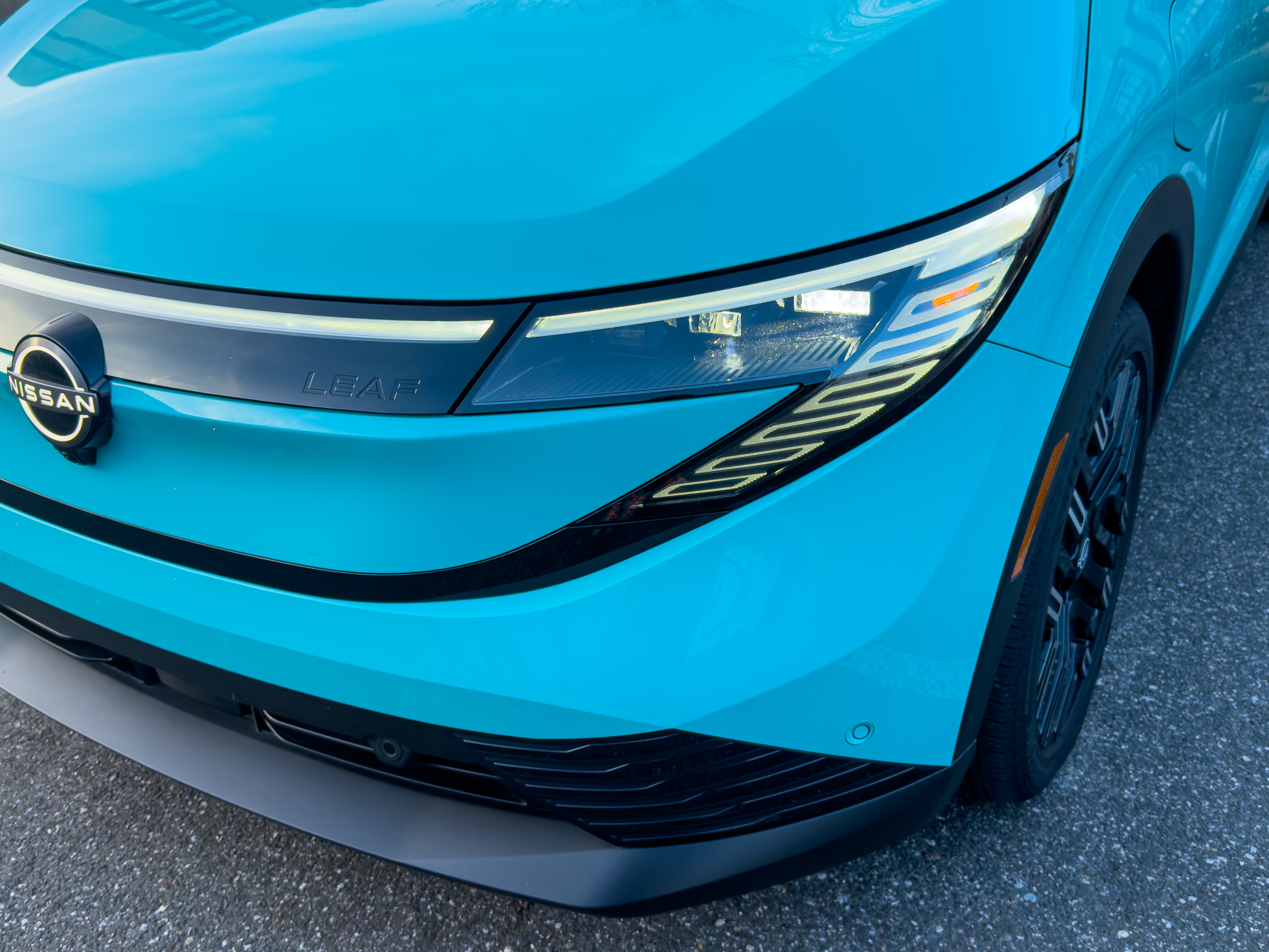
The Leaf has distinctive light clusters. And in Platinum+ spec, an illuminated hood logo.
Jonathan Gitlin
Jonathan Gitlin
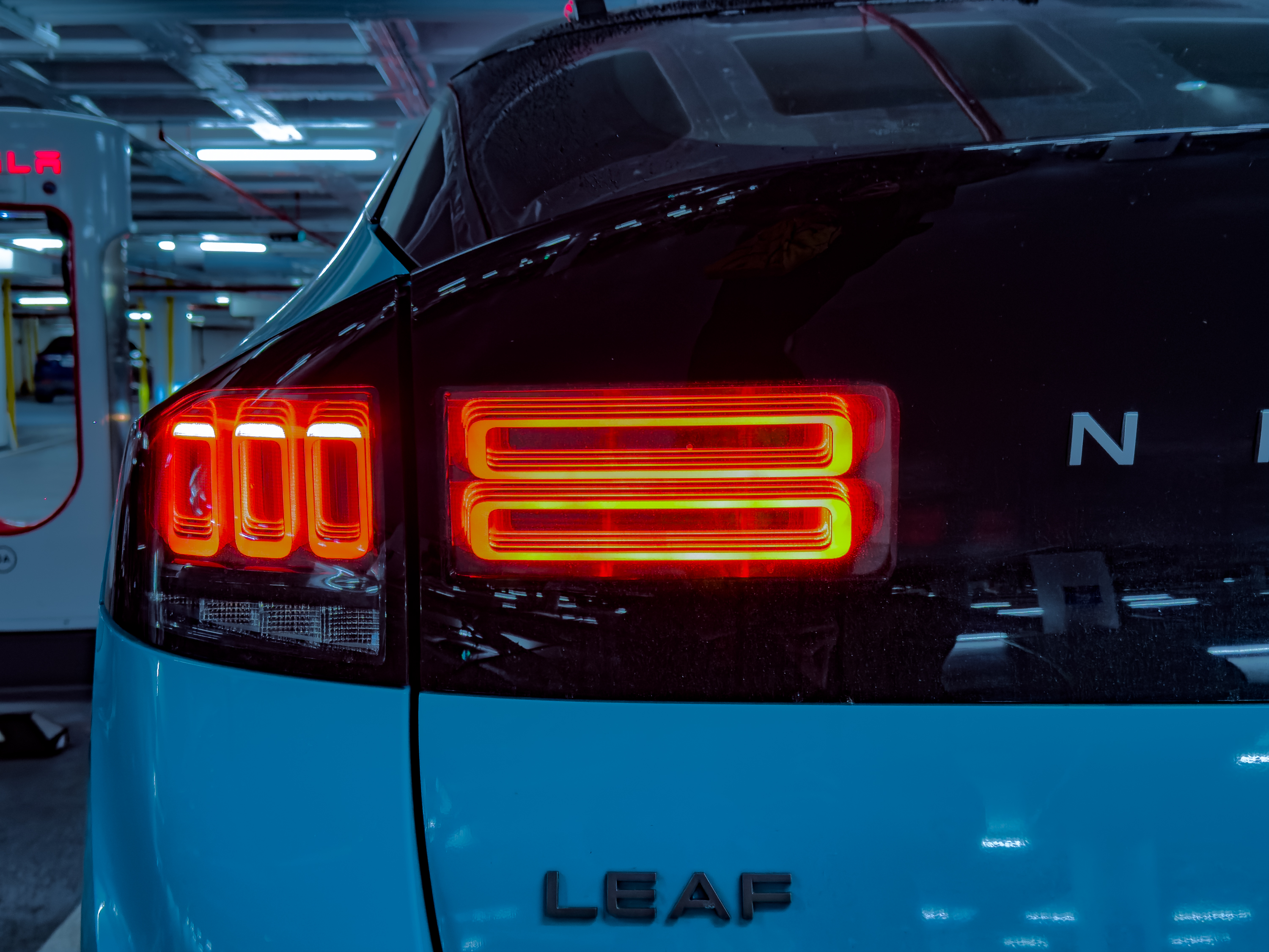
The tail lights are an easter egg of sorts: The 2-3 combination is ni san in Japanese.
Jonathan Gitlin
The Leaf has distinctive light clusters. And in Platinum+ spec, an illuminated hood logo.
Jonathan Gitlin
The tail lights are an easter egg of sorts: The 2-3 combination is ni san in Japanese.
Jonathan Gitlin
Those come as standard with the $34,230 SV+, along with a larger infotainment system, more USB-C ports, wireless phone charging, LED turn signals, the ability to use the J1772 charge port as a 120 V “vehicle to load” outlet, and a wider range of optional colors, including the bright Seabreeze Blue Pearl (an $800 option) you see in these photos. Our test car was the $38,990 Leaf Platinum+, which comes with all the above, plus larger 19-inch alloy wheels, heated front and rear seats, a 10-speaker sound system, a heads-up display, a powered hatchback, an interior vehicle-to-load AC socket, and a panoramic roof with electrochromic dimming.