SAARISELKÄ, FINLAND—If you’re expecting it, the feeling in the pit of your stomach when the rear of your car breaks traction and begins to slide is rather pleasant. It’s the same exhilaration we get from roller coasters, but when you’re in the driver’s seat, you’re in charge of the ride.



When you’re not expecting it, though, there’s anxiety instead of excitement and, should the slide end with a crunch, a lot more negative emotions, too.
Thankfully, fewer and fewer drivers will have to experience that kind of scare thanks to the proliferation and sophistication of modern electronic stability and traction control systems. For more than 30 years, these electronic safety nets have grown in capability and became mandatory in the early 2010s, saving countless crashes in the process.
Through a combination of cutting engine power and individually braking each wheel, the computers that keep a watchful eye on things like lateral acceleration and wheel spin gather it all together with the idea that the car goes where the driver wants it rather than sideways or backward into whatever solid object lies along the new path of motion.
Obviously, the quickest way to find out whether this all works is to turn it off. And then find a slippery road, or just drive like an oaf. Yet even when automakers let journalists loose on racetracks, they invariably require that we keep some of the electronic safety net turned on. Even on track, you can hit things that will crumple a car—or worse—and with modern tire technology being what it is, the speeds involved when cars do let go tend to be quite high, particularly if it’s dry.
Credit:
Jonathan Gitlin
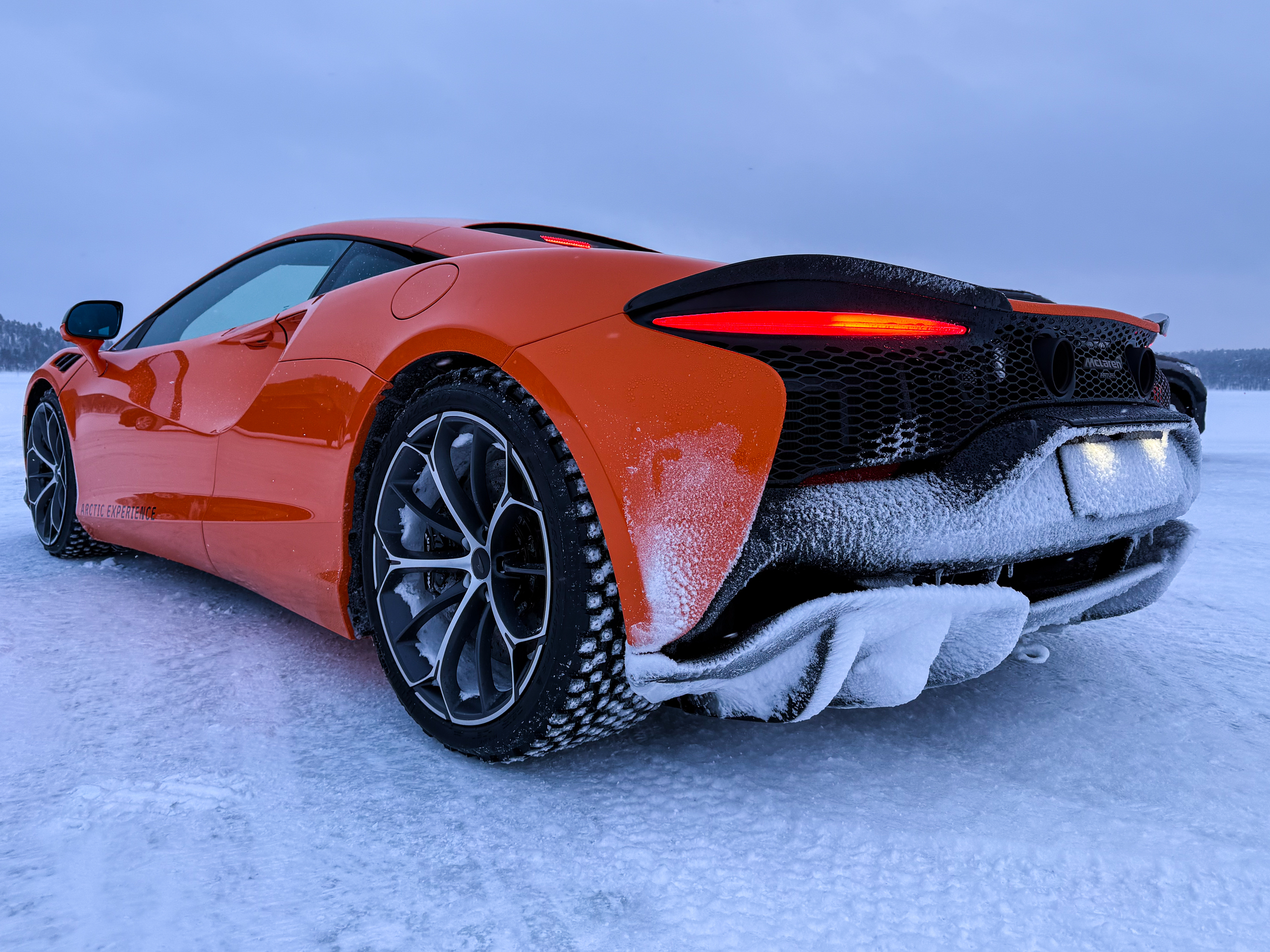
The Artura is probably my favorite McLaren, as it’s smaller and more versatile than the more expensive, more powerful machines in the range.
Credit:
Jonathan Gitlin
There are few environments that are more conducive to exploring the limits and capabilities of electronic chassis control. Ideally, you want a lot of wide-open space free of wildlife and people and a smooth, low-grip surface. A giant sand dune would work. Or a frozen lake. Which is why you can sometimes find automotive engineers hanging out in these remote, often extreme locations, braving the desert’s heat or an Arctic chill as they work on a prototype or fine-tune the next model.