Dubai residents have been driving to neighbouring Oman or even Saudi Arabia to try to secure seats on the limited number of flights out of the region, as a third day of global travel chaos triggered sharp falls in airline stocks.
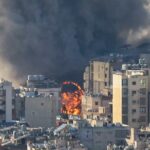

Airports in Dubai, Abu Dhabi and Qatar remained closed on Monday after Israeli and US attacks on Iran over the weekend sparked retaliation from Tehran, with charter groups vying to secure landing slots elsewhere in the region.
Tens of thousands of passengers have been stranded in the region by the closures, with many more in Asia or Europe unable to take planned connecting flights. Qatar Airways, Etihad and Emirates all postponed flights for another day.
By 11am UK time, more than half of the flights booked into the region for Monday had been cancelled, according to aviation data group Cirium. Some 4,000 flights in or out have been cancelled, adding to the thousands already cancelled over the weekend.
Shares in global airlines fell on the first trading day since the US and Israel launched strikes on Iran. International Airlines Group, owner of British Airways, fell about 5 per cent, and Air France-KLM, which has significant operations across Africa, declined 8.5 per cent. Lufthansa shed 6 per cent.
European airlines have most of their planes in their home countries. On Monday morning Lufthansa flew one plane from Abu Dhabi to Munich after repairs but was unable to carry passengers. However, charter flight groups have swept into the region.

EnterJet, which connects private jet clients with available aircraft, said bookings had jumped 40 per cent since Saturday. Muscat in Oman was “the only really viable option” to handle the “array of immediate UAE departure requests”, said founder Charles Robinson.
Others were driving 10 hours to Riyadh in Saudi Arabia to catch planes. Robinson said: “It appears there’s activity starting in Dammam as well, which is useful for those in Bahrain and Qatar.”
The EU’s aviation safety agency has warned civil aircraft not to fly in the entire region, making operations more difficult.
“It is a tricky question of actually finding vetted and certified aircraft to do the missions,” Robinson said. “We have more demand than aircraft that are available to offer in the region at the moment, vast uplift in flight requests — and as airspace opens fully, the private departures from the Gulf are expected to be very considerable.”
Private flight group Luxe Jets has chartered an A320 to fly from Muscat to Istanbul on Tuesday. The company plans another flight on Wednesday, and more later in the week.
“Half of Dubai is booking,” said Alexander Graham, Luxe Jets director, although some have had difficulty crossing the border with Oman. Securing landing slots at Muscat has also become more competitive, he added, with the company “trying to accommodate groups, families, pets” first.
Another operator was charging £20,000 per seat on a jet leaving Oman for Milan on Monday.
A Dubai-based Russian oligarch, speaking on condition of anonymity, told the FT he tried to book a private jet out of the Gulf by offering to pay twice the normal price for the Dubai to Moscow route but was told that “no exceptions could be made at this time”.
Raffaella Meledandri, founder of private jet operator Air-Dynamic, said customers had rushed to charter private aircraft out of the Gulf but would have to “be patient”, adding that private planes would resume operations from Muscat on Monday night.
An executive at a large global hedge fund with a presence in Dubai said: “We have been exploring how to evacuate people but it’s not easy.”
He added: “It’s pretty scary — this is going to have implications for some of my guys . . . The trade was not that you were getting exposed to geopolitics when moving to Dubai. It was not a consideration. People have moved families. This element of concern is new.”
However, others are determined to stay. One British expat in Abu Dhabi, who said he witnessed an explosion in front of the airport on Sunday morning as a Shahed drone flew 50 metres overhead, was “absolutely not” considering leaving.
“We’re absolutely safe here,” he said. “There are people saying they go downstairs in the basement when the alerts hit but honestly I think that’s just not helping — it winds people up and people get more anxious.”
Some residents are even “very antagonistic towards anyone considering leaving”, according to a Briton living in Dubai. “The idea of leaving ‘paradise’ of your own volition is just seen as so absurd . . . they’re going to have to ship me out,” she said.
Reactions differed by nationality. Being honed conflict survivors in their home country meant “the Afghans here are pretty relaxed”, said Saad Mohseni, the Afghan chief executive of the Dubai-based Moby Media Group.
Additional reporting by Simeon Kerr in Edinburgh, Costas Mourselas in London and Andres Schipani in New Delhi