Stay informed with free updates


Simply sign up to the Oil & Gas industry myFT Digest — delivered directly to your inbox.
Oil prices are on the brink of crossing the $100-a-barrel threshold for the first time in almost four years, as the Middle East’s largest producers start to curtail output with their barrels trapped in the Gulf by the US and Israel’s war with Iran.
Traders warned that the oil sector was facing one of its greatest ever challenges, with Iran’s attacks on tankers in the Strait of Hormuz affecting production in countries responsible for about a quarter of global crude supply.
Saudi Arabia, the UAE, Iraq, Kuwait and Iran are all either throttling back output or shutting fields entirely, as they risk maxing out storage tanks as crude backs up in the Gulf.
Further attacks on oilfields and energy infrastructure over the weekend also pose a new threat that could cause prices to soar, just four years after Russia’s full-scale invasion of Ukraine triggered the last energy crisis.
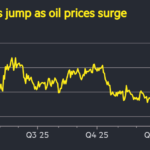
Last week US oil benchmark West Texas Intermediate posted its biggest weekly rise on record, surging 36 per cent to $90.90 a barrel, while international marker Brent crude hit $92.69. Both Brent and WTI were trading around $60 a barrel in early January.
Gains accelerated towards the end of last week, with Brent rising 8.5 per cent on Friday, and traders increasingly betting on a prolonged shutdown of the Strait of Hormuz — a chokepoint that normally accounts for at least a fifth of global oil and liquefied natural gas supplies.
“Unless the situation improves quickly I expect we’ll reach triple-digit Brent prices early next week,” said Richard Bronze, head of geopolitics at consultancy Energy Aspects.
“There’s been no real signs of a diplomatic off-ramp emerging while more Gulf producers are announcing production cuts, most tankers still aren’t risking going through the Strait of Hormuz and more energy infrastructure is getting attacked,” he said.
Goldman Sachs, one of the most influential banks in commodity markets, said late on Friday that crude and refined products such as gasoline and diesel could hit all-time highs “if Strait of Hormuz flows were to remain depressed throughout March”.
Brent hit $147.50 a barrel on the eve of the financial crisis in 2008 which, adjusted for inflation, is the equivalent of $218 today.
Refined fuel prices have already soared in the past week, with the Gulf becoming a significant supplier of diesel and jet fuel to Europe in recent years, often replacing Russian supplies.
Saudi Arabia’s oil-producing facilities were attacked for the first time in the current conflict on Saturday, with the kingdom saying it had intercepted 21 drones targeting the 1mn-barrel-a-day Shaybah oilfield, while the Berri field was also attacked.
Kayrros, a company that uses satellites to monitor oil infrastructure, said its latest imaging suggested Saudi Arabia had already reduced oil production as it looked to delay the point it runs out of storage. State oil company Saudi Aramco, the world’s top oil exporter, is rapidly trying to reorientate its crude shipments from the Gulf to the Red Sea through its back-up East-West pipeline.

Around 7mn barrels per day can be pumped across the country, in theory, roughly equal to Saudi Arabia’s normal oil exports. But the kingdom does not yet have the loading capacity or sufficient tankers positioned at its Red Sea port of Yanbu to ship out these volumes.
On Saturday, Kuwait Petroleum Corporation declared force majeure on oil exports and said it was reducing crude oil production, while Abu Dhabi National Oil Company also indicated it was trimming output at its offshore fields.
Iraq has already stopped more than half of its production while Qatar declared force majeure on its LNG exports earlier this week. All shipments of hydrocarbons from the Gulf have been trapped for more than a week, testing the region’s oil storage limits.
On the other side of the Gulf, Israel attacked a major fuel storage site near Tehran overnight, causing explosions and damaging levels of air pollution. Iran’s parliamentary speaker warned that the conflict could halt its oil production and exports.
There is growing speculation the US or one of its allies could target Kharg Island, Iran’s most important oil hub, which would have a devastating effect on Tehran’s ability to keep exporting oil. Axios reported the US was considering seizing the island on Iran’s west coast.
Ali Shihabi, a Saudi commentator close to the royal court, said Crown Prince Mohammed bin Salman had told Iran before the war that if there was a major attack on the kingdom’s oil facilities, Riyadh would target Kharg Island.