The Berkeley Art Museum and Pacific Film Archive’s retrospective “Theresa Hak Kyung Cha: Multiple Offerings” (on view through April 19, before a run at New York’s Artists Space from September 11 to November 21) turns the soaring galleries into a living archive—one that breathes, flickers, and speaks in many tongues.

The sweeping exhibition—the largest ever dedicated to the Korean American avant-garde artist and writer and her first retrospective in more than two decades—gathers more than a hundred works and archival materials, many on view for the first time, spanning performance, film, writing, mail art, and even ceramics made during her student years.
For many, Cha’s name is synonymous with one work: Dictee, the genre-defying 1982 text that moves between memoir, history, translation, and myth and has become a widely taught and influential cult classic in avant-garde, feminist, and Asian American literary circles. But this exhibition suggests that Dictee was only one node in a deeply interdisciplinary practice concerned with language, exile, and the fragile mechanics of memory.

Theresa Hak Kyung Cha in 1979Photo: James H. Cha. Gift of the Theresa Hak Kyung Cha Memorial Foundation.
Born in Busan, Korea, in 1951 and raised in the Bay Area after emigrating in 1964, Cha spent nearly a decade studying at the University of California, Berkeley, eventually earning four degrees while absorbing the conceptual and performance-driven art scene of the 1970s. The retrospective returns to those origins, beginning with student experiments—ceramics, fiber works, and early films—that reveal the artist already probing the slippage between speech and meaning.
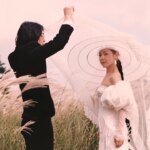
In one video, Cha mouths Korean vowels directly into the camera, the sounds withheld from the viewer. Photographs document early performance works staged across campus—acts of burning long strips of paper, unfurling text, or, in one piece called Aveugle Voix, wandering in white garments stamped with letters, unspooling fabric across her face as if language itself were also a veil. The title translates literally from French to “blind voice,” but when spoken, it also sounds like “the blind can speak.”
“She was always interested in these glitches between languages,” notes curator Tausif Noor, “in puns and wordplay, in the disconnect between what is written and what is heard.” Cha grew up speaking Korean, English, and French. “That interest in the possibility of expression, the limitations of language, runs throughout the whole of her work.”

“Theresa Hak Kyung Cha: Multiple Offerings” installation view at the Berkeley Art Museum and Pacific Film ArchivePhoto: Chris Grunder