Unlock the White House Watch newsletter for free

Your guide to what Trump’s second term means for Washington, business and the world
The writer, an assistant professor at Cornell University, is the author of ‘The Economic Weapon: the rise of sanctions as a tool of modern war’
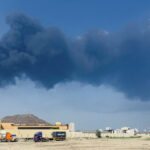
Iran’s effective closure of the Strait of Hormuz has sent shockwaves through the global economy. The Iranian threat to shipping in the Gulf is widely seen as an asymmetric retaliation against the US and Israel. But Iran has actually replicated a tactic that America has long practised in its use of sanctions: it has turned a key chokepoint in the world economy into a weapon to compel its adversary to de-escalate.
This is not the first time that the Trump administration has faced blowback from an adversary responding with their own economic weapons. Upon returning to office, Trump embarked on an assault on the global trade system by levying hefty tariffs on friends and foes alike. Several US allies succumbed and quickly signed trade deals to preserve their relationship with Washington. But not all countries acquiesced. China held firm and launched a counteroffensive. When new US export controls were unveiled in late 2025, Beijing retaliated by imposing controls on its exports of refined rare earths.
In the decades that followed the end of the cold war, America had an effective monopoly on major sanctions. That is no longer the case. Iran and China have now shown that the era of US dominance in economic warfare is over.
The Chinese critical minerals weapon struck US manufacturers in the defence, aerospace and automobile industries, leading to delays and production cuts in North America and elsewhere. China’s pressure on US supply chains eventually forced Trump into economic de-escalation. The deal concluded with Xi Jinping in South Korea in October 2025 amounted to a Sino-American truce in economic coercion. So far it seems to have held up.
Now, by embarking on another American war in the Middle East, Trump has unleashed a much larger set of risks. The entire world is experiencing the damage that broad-based economic coercion can inflict. By moving from “maximum pressure” sanctions on Iran to open war, the US prompted the Iranians to deploy an economic weapon of their own — cutting off 20 per cent of global oil and gas flows and one-third of the global fertiliser trade that passes through the Strait of Hormuz and enforcing that closure with missiles, drones and mines.
What does the end of the unipolar era in economic warfare mean for the global economy? For one thing, it is apparent that the US and its allies will face hard trade-offs, especially when seeking to use sanctions in the oil market. Iran’s blockade has caused such a large energy price shock that the Trump administration has temporarily relented on its sanctions on Russian oil.
The EU, which only recently celebrated its imminent decoupling from Russian gas, may now have to continue purchasing energy from Russia to avoid economic damage. Warding off the energy weapon used by Tehran has thus necessitated a dialling down of the economic war on Moscow. But although other countries are resorting to economic pressure more frequently, this does not mean that they will fare any better than the US. The failure of sanctions is a widespread phenomenon.
The economic blockade of Qatar by its Gulf neighbours from 2017 to 2021 was unsuccessful. Sanctions imposed by the Economic Community of West African States (Ecowas) have failed to mend relations with military juntas in Mali, Burkina Faso and Niger. And China’s use of rare earth export controls against Japan and its ban on Australian coal imports have made Tokyo and Canberra more rather than less antagonistic towards Beijing.
This is not surprising. Throughout the history of economic coercion, sustained use of sanctions has often prompted targeted states to increase their self-sufficiency and seek new partners. Diversifying trading patterns weakens the effects of pressure over time. After 2022, Russia reoriented its trade to Asian economies to avoid sanctions. Chinese companies have reacted to US tariffs by shifting production abroad, and cushioned the hit from export controls on chips by accelerating domestic innovation. In today’s sanctions-clogged world economy, more pressure can mean diminishing returns.
Indeed, the political and diplomatic usefulness of sanctions is declining. For a long time, one could argue that sanctions were, despite their imperfect record, at least a preferable alternative to open war. After the US attacks on Venezuela and Iran, this claim no longer seems convincing. Instead of averting military action, sanctions are now just as frequently paving the way to violent escalation. A world of persistent economic wars will, sooner or later, spiral into actual warfare.