At some point in North America, the atlatl was replaced by the bow and arrow, thanks to the latter’s increased arrow accuracy, distance, velocity, more frequent shots, plus the ability to shoot (and reshoot) from a number of different positions. There were also trade-offs, though: Using a bow costs more to make and maintain, for instance, and it requires both hands to operate, making it difficult to also hold a shield. Its widespread adoption probably occurred because the benefits outweighed the downsides.



It’s challenging to determine when the bow was introduced and how quickly it was adopted because the weapons are made with organic materials that tend not to be preserved, unlike stone, bone, or metal tools. So for this latest study, Eren and his co-authors focused on radiocarbon dating a carefully curated dataset of clearly identifiable weapons found in dry caves and rock shelters (naturally anaerobic environments).
Single origin or independent invention?
Credit:
Jennifer Ouellette
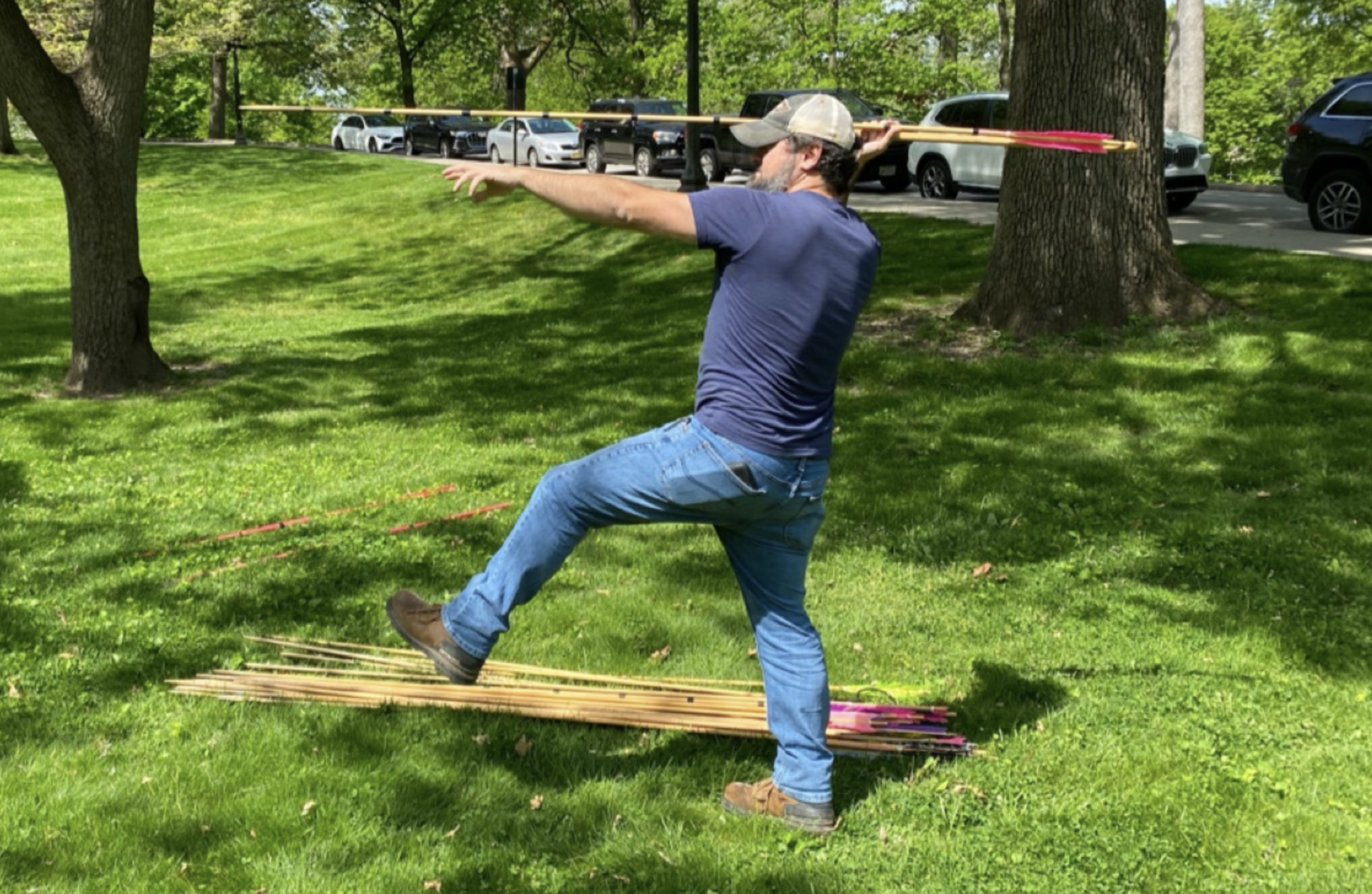
Metin Eren demonstrates proper form when throwing a spear with an atlatl.
Credit:
Jennifer Ouellette
The radiocarbon dating results showed that the bow and arrow emerged in North America roughly 1,400 years ago. However, in the north, that weapon coexisted with the atlatl for several centuries, while the bow proved to be disruptive almost immediately in the south, quickly rendering tools like the atlatl obsolete. For the authors, this is evidence of “a relatively late introduction that occurred nearly simultaneously across a vast area, followed by regionally distinct adoption trajectories.”
In other words, the bow and arrow likely had a single origin that then rapidly diffused through cultural transmission networks, with a few regional differences affecting the rate of replacement. Eren et al. note that there is also evidence from other studies of people in several geotemporal contexts converging on bow-and-arrow technology multiple times since the African Middle Stone Age. So more data is needed to make a definitive finding, and for now, at least, “such testing is beyond current archaeological resolution and analysis,” the authors wrote.