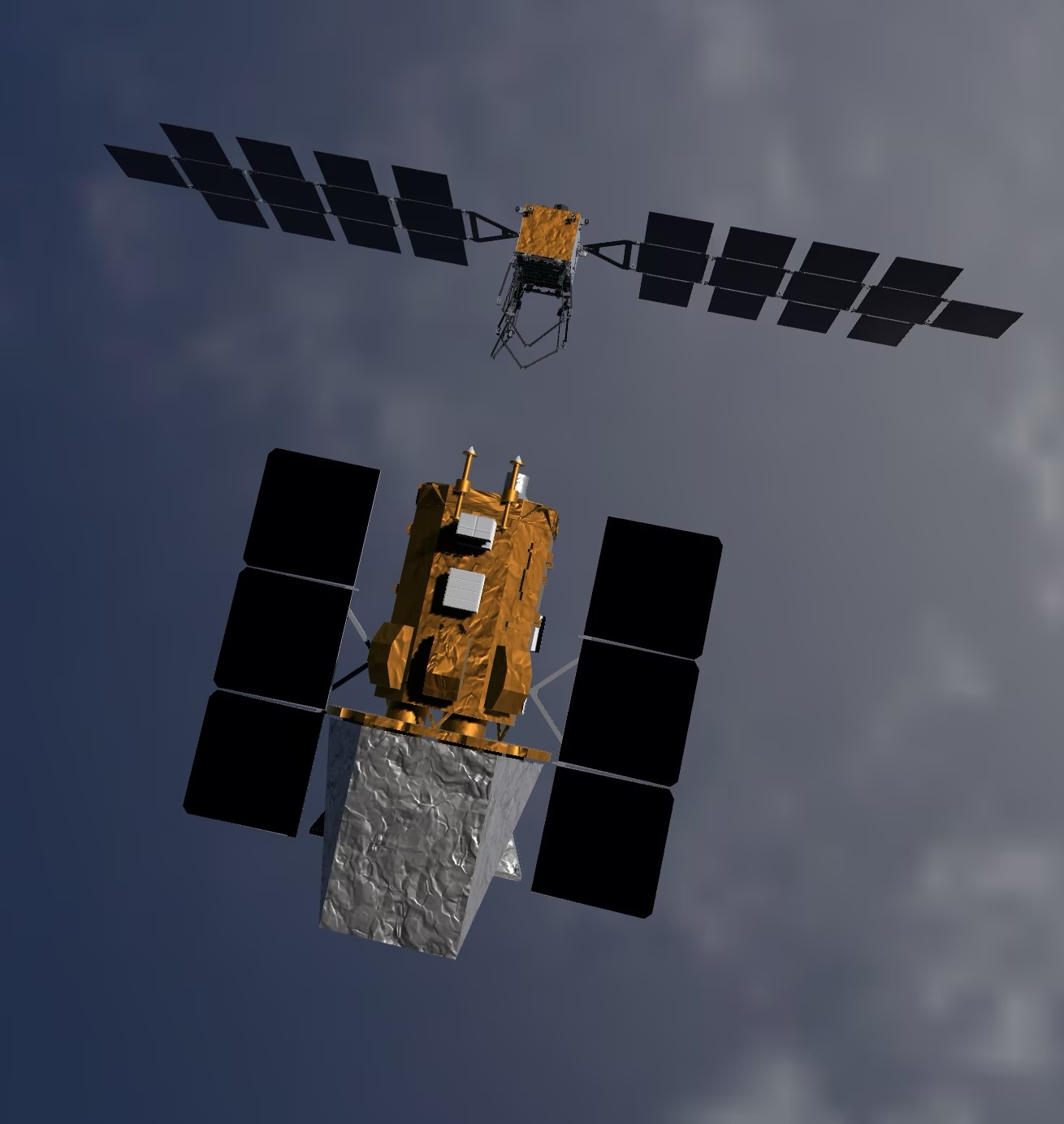
But the Swift spacecraft will surely crash back to Earth, likely before the end of this year, without a reboost. That’s where Katalyst comes in. The company’s robotic servicing spacecraft, named Link, will attempt to rendezvous and dock with the Swift satellite, then raise its altitude to give the observatory a new lease on life.



That is, if everything goes according to plan.
Credit:
Katalyst Space Technologies
Artist’s illustration of Katalyst’s Link spacecraft (top) approaching NASA’s Swift observatory (bottom).
Credit:
Katalyst Space Technologies
Deadline looming
There are a few things you should know about this venture. First, Swift was never designed to be captured or reboosted in orbit. Second, this mission is the first time Katalyst will attempt to dock with another satellite in space. And third, NASA gave Katalyst a daunting timetable of just nine months to build, test, and launch the rescue mission before Swift’s altitude falls too low for a safe rendezvous.
“This is really technically ambitious,” said Ghonhee Lee, founder and CEO of Katalyst.
Launch is scheduled for June 1, and there’s little margin for error. By late summer or early fall, Swift will slip below 200 miles (320 kilometers), too low for Katalyst to have confidence in controlling its spacecraft. “It’s a lot of drag with two big spacecraft docking together, ” Lee said. “Originally, we thought we had more time.”
NASA’s goals are twofold: first, demonstrate an important capability for the future of space exploration, and second, save Swift from a fiery demise and continue its scientific observations.
“We realized that you can’t get 100 percent guaranteed success on this,” Lee said.
When Ars visited Katalyst in late February, technicians were heads-down at work stations, soldering parts, assembling solar panels, and preparing components for environmental testing. For a traditional government space mission, a project might be at this stage of manufacturing years before reaching the launch pad.
“This is not quite as mature as you would expect,” one company official said. “Keep in mind that we started this whole thing about five months ago, so we are making great progress by those standards.”