Bitcoin has room to rally if diplomacy between Washington and Tehran continues to ease pressure on oil.



Since March 23, traces of significant de-escalation have emerged, with President Donald Trump ordering a 5-day pause for “constructive conversations.”
At the same time, reports have emerged that the United States had sent Iran a 15-point proposal through Pakistan, while Turkey also passed messages between the two sides.
While there is no ceasefire yet, and there is no sign of a settled negotiating track. Iran has publicly denied direct talks with Washington, and an Iranian military spokesperson said the United States was “negotiating with itself.”
Still, the signs of diplomacy have been real enough for markets to react, with Brent crude down 5.2% to $99.01 a barrel and US West Texas Intermediate down 5.1% to $87.62.
On the other hand, Bitcoin rose 1.6% to maintain its steady resilience above $71,000 as traders pared back some of the inflation and rate fears that had built up during nearly four weeks of war.

Why this tentative diplomacy moves market
The supply side explains the outsized reaction to headlines that amount to little more than mediated messaging.
Iran is OPEC’s third-largest producer, pumping about 3.3 million barrels per day of crude and another 1.3 million bpd of condensate and other liquids. About 90% of its crude leaves through Kharg Island via the Strait of Hormuz, with exports recently running between 1.1 million and 1.5 million bpd.
Data from the US Energy Information Administration shows that flows through the Strait of Hormuz averaged 20.9 million bpd in the first half of 2025, representing roughly 20% of global petroleum liquids consumption. About 20% of the global liquefied natural gas trade also transited the strait in 2024.
However, that volume has all but halted, with Andre Dragosch, Bitwise’s Europe head of research, pointing out that there has been “1 ship today” that has passed through the path.
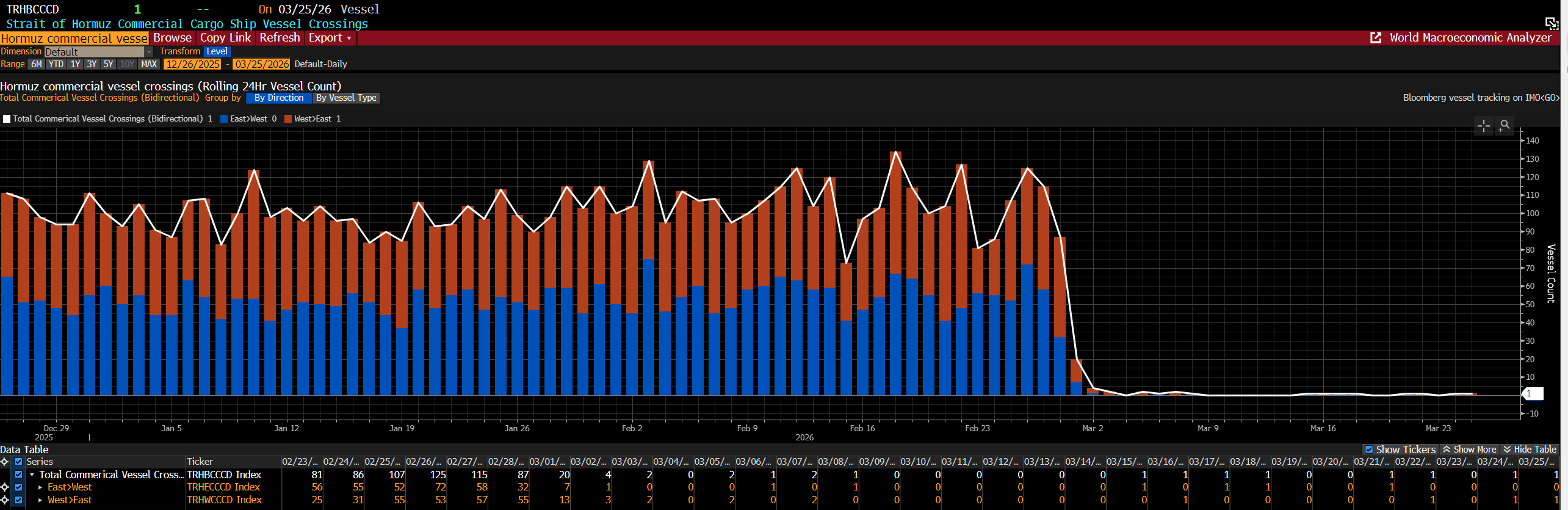
So, any discussion of ceasefire terms, shipping access, or sanctions relief therefore carries direct, volumetric market relevance for the oil market.
The forward curve sharpens the case. In its March outlook, the EIA forecast that Brent would stay above $95 per barrel over the next two months, then fall below $80 in the third quarter and toward $70 by year-end if disruptions ease and inventories rebuild.
The agency projected global oil inventories to rise by an average of 1.9 million bpd in 2026, once production again outpaces consumption.
This means that a credible diplomatic process does not need to create an immediate surplus supply. It only needs to make that softer path look more probable.
The European Central Bank’s March 2026 staff projections quantify the stakes. The ECB modeled an adverse energy scenario with oil at $119 per barrel and gas at €87 per megawatt-hour in the second quarter, lifting euro-zone inflation by 0.9 percentage points.
Federal Reserve research separately finds that higher oil prices directly push up headline inflation and, over about eight quarters, create a smaller but statistically significant pass-through into food and core prices.
Considering this, crypto market maker Wintermute put it in trading terms, explaining that if Brent stabilizes near $100 and diplomacy holds, the inflation fears tied to energy disruption should ease enough to let “some of the rate-cut expectations erased last week” return.
The oil-to-rates transmission
The bullish case for Bitcoin here is that lower oil prices ease inflation pressure. Additionally, it reduces the likelihood that central banks will keep rates tighter for longer and improves the liquidity backdrop for risk assets more broadly.
Notably, Bitcoin has mostly traded less like a geopolitical hedge and more like a high-beta expression of global liquidity conditions during the ongoing US-Iran conflict.
For context, the top crypto’s recent rebound above $70,000 not not driven by any crypto-native catalyst. Instead, this came amid a sharp recovery in technology shares and a stabilization of broader market risk.
The flow data reinforces that reading. According to CoinShares, digital-asset investment products pulled in $230 million last week, with $219 million going to Bitcoin, even after $405 million in outflows following the Federal Open Market Committee meeting.
CoinShares attributed the pressure to the Fed’s hawkish stance, not to the Iran conflict. The dominant driver has been rates and liquidity and not geopolitics in isolation.
That is why the repricing in interest-rate futures carries weight. Over the past several weeks, the conflict threatened to deliver a stagflation shock as oil prices surged to record levels.
CryptoSlate had previously reported that rate futures had implied virtually no chance of Fed cuts before mid-2027 as the conflict drove energy higher. However, after Tuesday’s diplomacy headlines, bets on a December rate hike dropped to about 16% from 25%.
Federal Reserve Governor Michael Barr reinforced the hawkish backdrop on March 24, saying policymakers may need to keep rates steady for “some time” and that he would need to see evidence that inflation is “sustainably retreating” before considering further cuts.
What could happen next?
A drawn-out diplomatic process with no formal breakthrough could still help Bitcoin if it caps oil. Brent holding near current levels, or drifting lower as shipping fears ease, would likely keep pressure off yields and reduce the urgency around higher-for-longer policy pricing.
The EIA’s path toward sub-$80 oil in the third quarter offers a macro framework for that outcome. Under that kind of easing, BTC would have a clearer opening to revisit and push through the highs reached earlier this month.
Meanwhile, a more credible ceasefire path would strengthen that case. The larger effect would come from convincing markets that Hormuz is moving back toward normal use, that regional energy infrastructure is no longer in the crosshairs, and that the inflation shock from the war is beginning to fade.
The ECB’s projections show how much difference that can make. Even small changes in the assumed oil path produce meaningful changes in inflation and growth forecasts.
However, a collapse in talks would revive the entire chain in reverse. Oil would likely rise again, shipping-risk fears would rebuild, and markets would have to price a tougher policy path from the Fed and other central banks.
Past market performances have already shown how quickly that adjustment can happen. In the space of a few days, traders swung from expecting cuts later this year to pricing in a meaningful chance of a December hike, before easing those bets when oil fell amid diplomatic headlines.
Bitcoin can still rise during wartime, but the cleaner path higher comes when the energy shock begins to unwind.