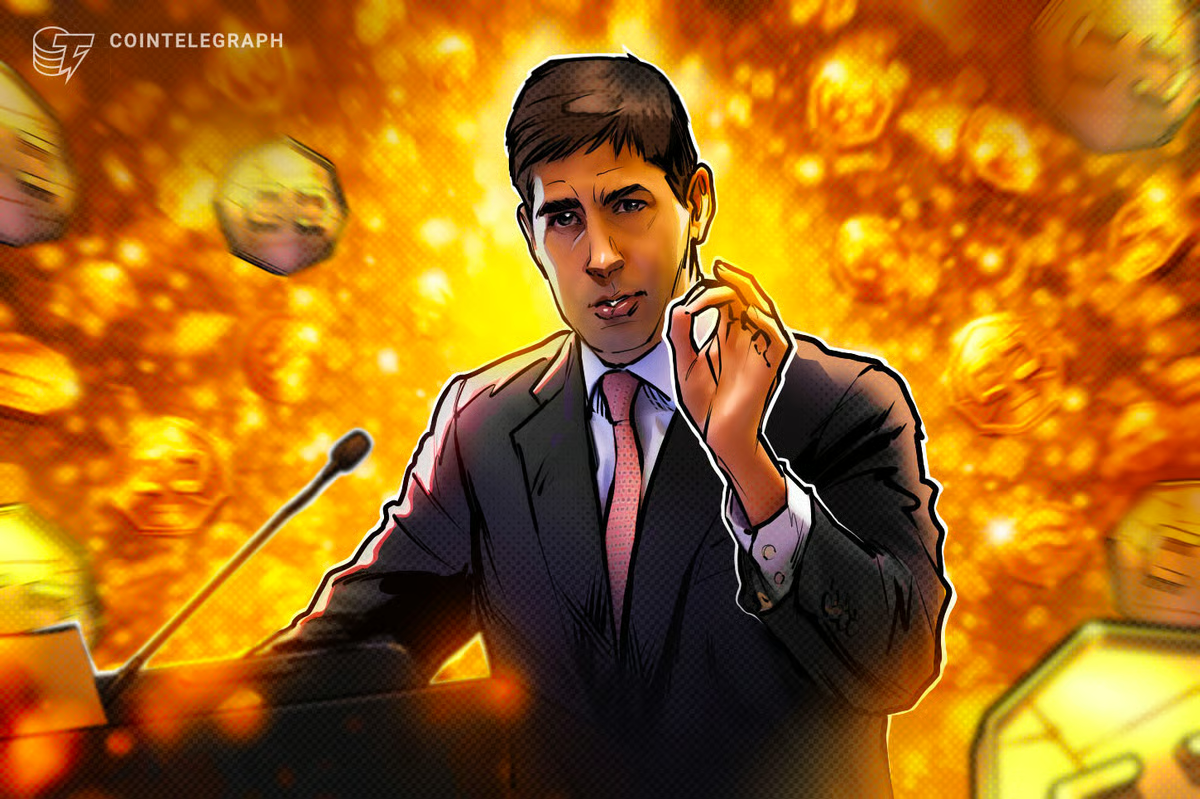
The US Senate could soon hear testimony to confirm financier Kevin Warsh as the new chair of the Federal Reserve.


Warsh, who previously served on the Fed’s Board of Governors from 2006 to 2011, has criticized the central bank’s policies under current chair Jerome Powell. Warsh has called for “regime change” and lower interest rates.
Regarding crypto, Warsh has a somewhat nuanced approach. He hails Bitcoin as a sustainable store of value, but claims it doesn’t function as money.
Lower interest rates and a fairly open attitude toward crypto could be good news for digital asset prices, which most investors perceive as risk-on. But even if Warsh passes his nomination, there’s no guarantee he’ll affect the changes expected.
Warsh wants to lower Fed interest rates, but can he?
Warsh, a graduate of Stanford and Harvard, started his career at Morgan Stanley, where he eventually became a VP and executive director. He then served as an executive secretary of the White House National Economic Council under President George W. Bush.
Bush nominated him to the Board of Governors of the Federal Reserve in 2006, where his hawkish views on inflation often differed from his colleagues. He was critical of the aggressive use of its balance sheet, which he said led to a period of “monetary dominance” that artificially depressed rates.
Some of this appears to have changed in recent years. In a November 2025 op-ed for the Wall Street Journal, Warsh criticized Powell’s leadership at the Fed, claiming that “inflation is a choice, and the Fed’s track record under Chairman Jerome Powell is one of unwise choices.”
He said “credit on Main Street is too tight” and that the Fed’s balance sheet, which is “bloated” due to past crisis-management efforts, “can be reduced significantly.”

“That largesse can be redeployed in the form of lower interest rates to support households and small and medium-size businesses,” he said.
Plans for cutting interest rates come at an economically fraught time. The US and Israel’s joint attack on Iran, which could soon escalate into an invasion if US President Donald Trump so decides, has wreaked havoc on oil prices.
Increasing oil prices had a direct effect on the core inflation metrics the Federal Reserve uses when considering rate changes. This could put the damper on any plans for rate cuts, at least certainly under Powell.
Warsh told Barron’s that the “core theory of inflation that the Fed is using” is “mistaken.” He said that “we need to fundamentally rethink macro, which is a fundamental rethink of the core economic models that the Fed is using.”
In his accounting, rising wages and commodity prices are not to blame for inflation. Rather, “at the core, I think inflation comes about when the government spends too much and prints too much.”
Returning to monetarism, as well as dumping some of the debt held by the Federal Reserve, could help address inflation concerns, in his view.
Bankers and former Bush administration officials have congratulated Warsh on the nomination. Former US Secretary of State Condoleezza Rice said the Fed would “benefit from his steady, principled leadership.”
“He understands the central bank’s key role for the United States and our allies around the world,” she said.
Bank of England Governor Andrew Bailey has also welcomed Warsh’s nomination. He said that he knew both Powell and Warsh well, and that “They’re both very qualified.”
Qualifications aside, Warsh may find it difficult to enact his preferred policies.
Roger W. Ferguson Jr., the Steven A. Tananbaum Distinguished Fellow for International Economics at the Council on Foreign Relations (CFR), and Maximilian Hippold, a research associate for international economics at CFR, wrote that Warsh won’t revolutionize the Fed.
They said that the chair alone does not make inflation rate decisions. “They are determined by the Federal Open Market Committee (FOMC), a twelve-member body that includes seven Fed governors and five regional Fed presidents.” The chair can’t change policy without convincing a majority.

Others argue that Warsh’s interest in lowering interest rates is a recent pivot and may not be a core conviction around which he will focus central bank policy. A December 2025 analysis from Deutsche Bank noted Warsh’s response to the global financial crisis in 2008, when he was a Governor at the Fed.
“His views while he was a Governor around the GFC [global financial crisis] at times skewed more hawkish than his colleagues,” the report read. “Although Warsh has argued for lower rates recently, we do not view him as structurally dovish.”
They further questioned Warsh’s plans to lower interest rates and cut assets on the Fed balance sheet. “This trade-off would only be feasible if regulatory changes are made that lower banks’ demand for reserves. While several Fed officials have made this argument recently, including Vice Chair of Supervision Bowman and Governor Miran, it is not obvious these changes are realistic in the near-term.”
“The chair has just one vote amongst a particularly divided committee.”
Warsh’s nomination and Fed independence
Commentators have also drawn attention to Warsh’s connection to the Trump administration. Warsh’s father-in-law, Ronald Lauder, is a classmate of Trump and a major donor to his political campaigns.
His relatively recent opinions on low interest rates also make him uniquely suited to the role, at least in Trump’s eyes. Ferguson and Hippold wrote, “Trump believes he has found a successor who will align with his economic priorities in Warsh.”
The president has long bemoaned Fed officials who supposedly promise rate cuts, but then raise them once in office. “It’s too bad, sort of disloyalty, but they got to do what they think is right,” he said in a speech at Davos last year.
Trump has long pushed for lower interest rates, claiming that they are needed to spur his economic development plans. Powell’s refusal to acquiesce to the White House’s request led to political scandal.
Last year, the Department of Justice (DoJ) opened a criminal investigation into Powell, alleging that he misappropriated billions of dollars for new offices for the Federal Reserve.
A federal judge recently quashed the DoJ’s subpoenas in the case. Judge James Boasberg wrote in a memorandum opinion, “A mountain of evidence suggests that the dominant purpose is to harass Powell to pressure him to lower rates. For years, the President has publicly targeted Powell because the Fed is not delivering the low rates that Trump demands.”

Regarding his pick, Trump said in a January press event in the Oval Office that it would be “inappropriate” to ask Warsh about his stance on interest rates. “I want to keep it nice and pure, but he certainly wants to cut rates, I’ve been watching him for a long time.”
Just a couple of weeks later, in an interview with NBC, Trump said Warsh understands that he wants to lower interest rates. “But I think he wants to anyway. If he came in and said ‘I want to raise them’ […] he would not have gotten the job.”
But Warsh hasn’t “gotten the job,” at least not yet. He will face tough questioning from Democrats on the Senate Banking Committee, possibly as soon as April 13.
In a letter lambasting Warsh’s role in bailing out banks in 2008, Senator Elizabeth Warren, who serves on the committee, said, “I have no doubt that you will serve as a rubber stamp on President Trump’s Wall Street First agenda.”
Warren expected written responses to this, and to Warsh’s opinion about Trump’s “witch hunts” against Powell and Fed Governor Lisa Cook, by April 2.
Magazine: Nobody knows if quantum secure cryptography will even work