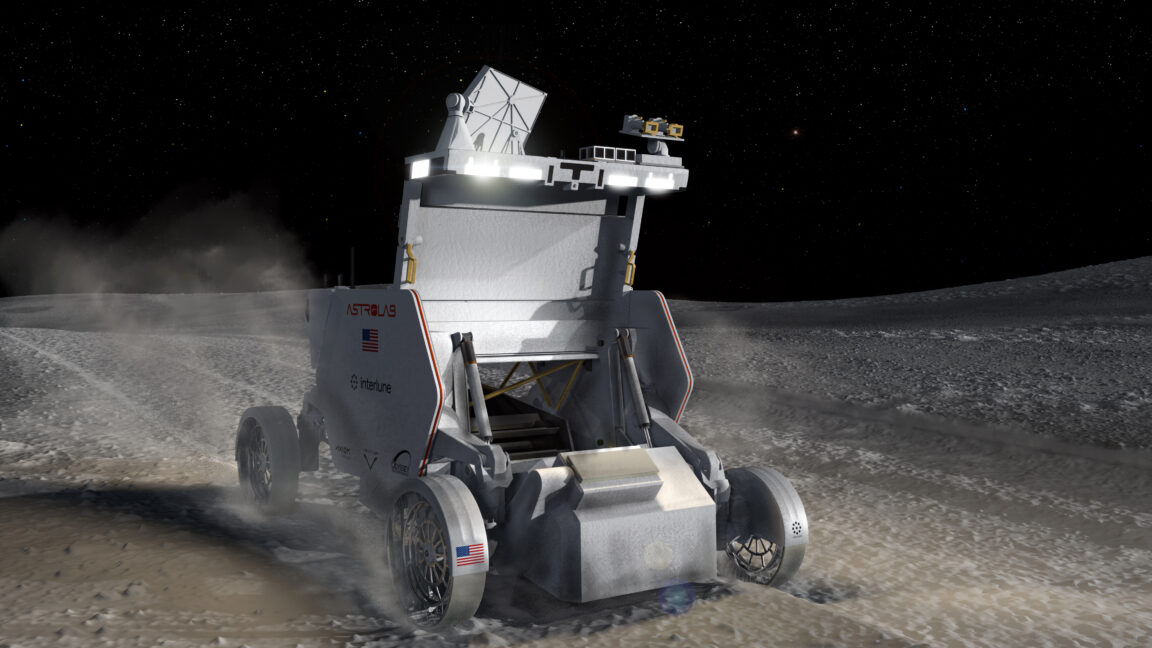
Starting smaller with FLIP
This is not the first time the two companies have worked together. Last August, Interlune announced that it would fly a multispectral camera on a smaller prototype rover being built by Astrolab. This camera will be used to estimate helium-3 quantities and concentration in Moon dirt, or regolith.



This FLIP rover, about the size of a go-kart, is due to launch later this year on a lunar lander built by Astrobotic. It will fly atop the Griffin lander, taking the place of NASA’s VIPER rover, which has been moved to another spacecraft.
The mission will therefore be a learning exercise for both Astrolab, in testing out its software and other features of a small lunar rover, as well as Interlune, which will seek to ground truth data about the concentration of Helium-3 that has previously been estimated from samples returned to Earth during the Apollo program.
In addition to FLIP, Astrolab is developing a larger rover, FLEX, that is about the size of a minivan. This vehicle has a horseshoe-shaped chassis that can accommodate about 3 cubic meters of payload. This allows for a broad array of activities, from carrying multiple scientific instruments across the Moon and providing a long-distance rover for two astronauts, to moving large equipment or, in the case of Interlune, serving as a mobile harvester.
“Our thesis is to make the most versatile platform possible so we can serve a wide array of customers and achieve NASA’s goal of being one customer among many,” said Jaret Matthews, Astrolab founder and chief executive, in an interview. “So we have essentially a modular approach that allows us to either pick up cargo or implements or payloads. And so in this case, the excavating equipment that Interlune is developing would basically go under the belly of the rover.”