This article is an on-site version of our Inside Politics newsletter. Subscribers can sign up here to get the newsletter delivered every weekday. If you’re not a subscriber, you can still receive the newsletter free for 30 days

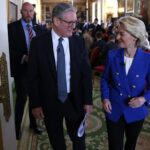

Good morning. Keir Starmer gave a press conference yesterday about the Greenland crisis. Some thoughts on something he didn’t say in it in today’s note.
Inside Politics is edited by Georgina Quach. Follow Stephen on Bluesky and Georgina on Bluesky. Read the previous edition of the newsletter here. Please send gossip, thoughts and feedback to insidepolitics@ft.com
On leadership in dangerous times
Because I know how to have a good time, I wondered what we wrote during the Cuban missile crisis in 1962 and how Harold Macmillan’s response was covered, so I decided to have a look in our archive:

(Fun fact for readers as cool as me: the 13-day period of the crisis is also, unless I am very much mistaken, the first time that the suggestion of a referendum on the UK’s membership of what is now the EU appeared in our pages. The suggestion came from Arthur Bottomley, the Labour MP for Middlesbrough East.)
Not a million miles away from our coverage of Keir Starmer’s response to the Greenland crisis. But the big and important difference back then is that the average British person knew full well what the consequences might be if the Cuban missile crisis spiralled out of control. Teenagers made morbid jokes about being able to see mushroom clouds on the horizon. Reading the archives of more downmarket newspapers tells me that people stockpiled food, engaged in nuclear drills and in some cases simply got drunk to ease their worries.
Now, I’m not saying that any of these things would be good or useful reactions now. But I think there is a disconnect between the scale of the crisis that the Labour government and indeed all Nato members are facing, the possible downside risks, and the British public’s understanding. (I think this is true of most European states that are not frontier states, but this is a newsletter about British politics.)
How much has the average person internalised George Robertson’s warning that “we are underprepared, we are underinsured, we are under attack. We are not safe”? Or Blaise Metreweli’s warning that the “frontline is everywhere”? The answer, obviously, is “not at all”, because if they had, people would be demanding that we spend more on our defence or that we radically realign our foreign policy to side with Russia. (I’m not saying the latter is desirable or possible: I’m just saying that “the general public becoming more aware of the situation” would, I think, tilt both ways: some people would become more concerned that we take steps to defend ourselves, others that we seek a new approach to Russia).
We are some distance away from being a society like Latvia, where the central bank governor said that Europe was already at war with Russia, though that assessment is one you can easily hear from members and former members of the UK’s defence establishment. (Robertson and another Labour peer, Alan West, made the same point on the Lord Speaker’s podcast late last year.)
The big thing that Starmer needs to do is use set-piece events — such as yesterday’s press conference — and the pulpit that comes with being prime minister to set out how high the stakes facing the UK are. Thus far, he isn’t.
Now try this
This week, I mostly listened to Chvrches’ new single, a cover of Robert Palmer’s Addicted to Love, while writing my column.
Top stories today
-
Unhappy reading | The unemployment rate in the three months to November remained at 5.1 per cent, hovering at its highest level since early 2021, following a long period of weak hiring. Today’s data also showed UK wage growth slowed as employers cut headcount in the run-up to the Budget.
-
‘GREAT STUPIDITY’ | Donald Trump has accused the UK of “stupidity” and “weakness” over its plan to transfer ownership of the Chagos Islands, including the US air base of Diego Garcia to Mauritius, citing the move as a reason for Washington to seize Greenland. Nigel Farage, who has pledged to overturn the Chagos Islands agreement, posted on X: “Thank goodness Trump has vetoed the surrender of the Chagos Islands.”
-
Hold up | At yesterday’s press conference Keir Starmer said he did not think Donald Trump would use military force to seize Greenland as he warned that Britain would incur “huge damage” from a trade war with the US. At Davos, US Treasury secretary Scott Bessent urged America’s trading partners to “take a deep breath and let things play out”, adding that “the worst thing countries can do is escalate against the US”. You can keep updated on Trump’s meeting over Greenland by following our live blog.
-
Walk the walk | Despite the government’s promises to raise defence spending, military experts and industry executives have warned little new money has gone on contracts for conventional capabilities. Instead, the bulk has been absorbed by other factors such as inflation and the country’s nuclear programme.
-
Spring in the state step | Keir Starmer’s “enforcer” will set out plans to give top-performing civil servants bumper bonuses worth tens of thousands of pounds as he warns that the government “has fallen unacceptably behind” the private sector.