What it means to be a dyke has zigged and zagged a lot since the days of The L Word, and thank goodness it has. In a new monograph, photographer Emily Lipson collects images of 50 different people, shot over five years, who identify as members of the dyke community—among them Evie Saunders, Ama Elsesser, and Louisa Jacobson. The result is a joyful and naturalistic celebration of the term’s many meanings and manifestations.

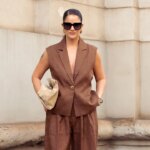

This week, Vogue spoke to Lipson about queer longing, self-recognition, drawing inspiration from ballet. Read that conversation—and see exclusive images from her book, aptly titled Dykes—below.
Vogue: How did the spark for Dykes first get lit for you?
Emily Lipson: Honestly, it didn’t feel like a spark so much as a slow recognition. I realized that the images I was most invested in making, the ones that felt alive to me, were all circling the same people, the same energy, the same negotiations around gender, intimacy, presentation, belonging.
For my first book, I knew I couldn’t commit to a single aesthetic—I shoot digital, film, I use AI, I make collages by hand, and I print and use dyes. There’s a lot of differing and contradicting aesthetic approaches to photography going into my work and it’s all sort of smashed together in this book. Sometimes it gives me this sort of existential dread that I’m not branding myself enough as an artist. But the thought occurred to me that I need to work in themes, not aesthetics, so the choice for my first book was very easy because it’s the most personal to me but also very open.
I want to be very clear about something: the book isn’t about defining a community. It’s about resisting simplification. As an artist I can’t make in one way, and dykes shouldn’t be seen in one way; it’s all sort of saying the same thing.
The talent lineup for Dykes is incredible. How did you go about assembling such a diverse and cool roster?
It wasn’t assembled so much as accumulated. These are people I’ve met through life, friends, collaborators, exes, people I’ve danced with, people I’ve worked with, people I’ve disagreed with. The project grew through trust and time, not casting. I was interested in photographing a community that isn’t unified by taste or politics or even mutual likability, but by a shared recognition of self. Also, there’s something I’ve been thinking a lot about about the queer experience. Queer fantasy can exist so much inside of us that sometimes it’s better than the real thing. So much of the queer experience is living inside that longing, sitting inside that awkwardness. I wanted to play with that in the book—there’s a lot of in-your-face images and then an alluding to. I’m interested in that discomfort of wanting to see more or not being given something fully.