


“House” is still considered one of those premium TV dramas that we can’t stop streaming today. As Dr. Gregory House, the caustic head of Diagnostic Medicine at the fictional Princeton–Plainsboro Teaching Hospital, Hugh Laurie was magnetic. Laurie alone was a major factor in why the Fox medical drama ran for a full eight seasons from 2004 to 2012, when “House” wrapped up with a shocker of a series finale. But there was more to the show’s success than its outstanding lead performance.
In a 2008 interview with Monsters and Critics, executive producer Katie Jacobs was asked about what set the show apart, and from her point of view, much of it came down to subverting established medical drama tropes. “I want a medical show, but I don’t want to see white coats going down the hallway,” the producer recalled one network executive noting during a conversation about the proposed series. “That was one of the many scenes that contributed to the idea of ‘House.'” In other words, “House” was exactly what the doctor — or executive, in this case — ordered.
Many programs have used the walk-and-talk technique to great effect, but “House” made it into an art form. The brisk pace served to heighten the ambient tension created by its protagonist’s cranky manner and his underling’s eagerness to meet his impossible expectations (it’s no wonder he was based on Sherlock Holmes). But showing off his limp also served as a visual reminder that House himself was always suffering, creating sympathy in an otherwise insufferable character.
House was a medical drama unlike any other
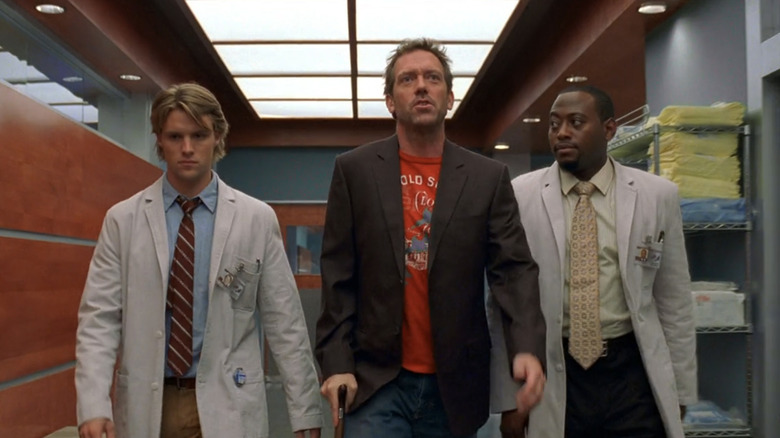
When asked about the show’s use of walk-and-talk scenes, Jacobs praised Laurie for being such a unique and towering figure. She noted how his physique made these scenes “pop,” adding how shooting “on the move” creates an “urgency and an intensity.” This, again, was the perfection of Hugh Laurie — who was recently cast in Apple TV’s “The Wanted Man” — who made such simple moments so visually distinct.
“I think that Hugh is so mesmerizing,” she added. “Here he is with a cane and a limp; yet he’s able to lead the charge. It was never a conscious decision. It was more of just a creative, ‘Oh, that seems right’ kind of decision.'” While Laurie deserves much of the credit, the idea of subverting a well-worn TV trope in this way — and getting House out of a lab coat — seems to have stemmed from Jacobs’ meeting with that forward-thinking executive.
For a series that thrives on momentum, the walk-and-talks feel quite natural. Nevertheless, the subtle difference between a “House” version of this technique and those of other medical dramas was one of many things that helped set it apart. Considering that “House” was, at one point, the most-watched series in the world, it was certainly the right spark of inspiration for the series.