Which is why promotional materials for the exhibition feature not a grand gown of engineered Rococo fantasy—in green silk brocade with coral and cream-colored botanical motifs—or even the emotional heart of the show, a diminutive and comparatively humble-looking corset worn by a young Marie-Antoinette. Instead, they star an altogether different kind of royalty: Utica Queen, né Ethan David Mundt, a favorite in RuPaul’s Drag Race (season 13), in a portrait shot by photographer Eric Magnussen.


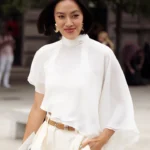
“The 18th century had already been revisited, altered, and fantasized over, in theater and in art, before it ever came down to us,” says Pascale Gorguet Ballesteros, the show’s curator and the head of the department of 17th and 18th century clothes and dolls. “You see a pastel wig, pastel clothes, lace, a rose and you know we’re talking about the 18th century.”
In the opening displays, women’s fashion is framed as nothing less than a revolution in its own right. The body becomes a canvas for embellishment, defined by artificial constructions, framed by spectacularly embroidered silks and brocades, and lavished with layer upon layer of ornately worked fabric and trim. As the rooms progress, the fashionable robes à la française, à l’anglaise, and à la piémontaise—whose back panels made it fashion’s first transformable, hybrid dress—give way to the narrowed and simplified silhouettes that prevailed through the next 150 years of political upheaval and social change.
One constant is the Pompadour rose, which resurfaced pointedly in the 19th-century when conservatism was on the rise and the bourgeoisie looked to the more reassuring values of the Ancien Régime. But that bloom, Gorguet Ballesteros notes, isn’t about nostalgia: it was a political statement, a symbol of a lost world in an intolerable present. A bodice once belonging to the Belle Époque dancer Cléo de Mérode illustrates that fantasy, all blush and ivory silk satin with Point de Venise lace and delicate silk embroidery. While there may be nothing historically accurate about that piece, the emotional message is there.
And the message resonates as the show culminates in runways past and present. A Givenchy evening gown from fall 1957, in gray taffeta with a pleated back and sculptural skirt appears to be in direct conversation with all that came before, recalling how couture’s postwar infatuation with the 18th century was as much political as aesthetic. Other love letters to French heritage include an embroidered couture look by Galliano from the fall 2007 “Bal des Artistes” collection, in icy blue shot-silk taffeta, tulle, and tiered flounces. A redingote from Ghesquière’s spring 2018 collection for Louis Vuitton, paired on the runway with sports shorts and sneakers, pays homage to the habit à la française. And straight from the spring runway comes the Pompadour gown, the opening look in Vivienne Westwood’s 2026 bridal collection—a reinterpretation of the late designer’s favorite dress.
“The 18th century is more than ever a source of comfort,” Gorguet Ballesteros says. “When you live in anxious times, there’s something soothing about lightness, about the happiness of color. Aesthetic emotion and beauty relieve stress.”
“Fashion in the 18th Century: A Fantasized Legacy” runs through July 12, 2026, at the Palais Galliera, 10 Avenue Pierre Ier de Serbie, Paris 16th arrondissement.

Photo: Nicolas Borel/ Courtesy of Palais Galiera