
Credit:
NASA
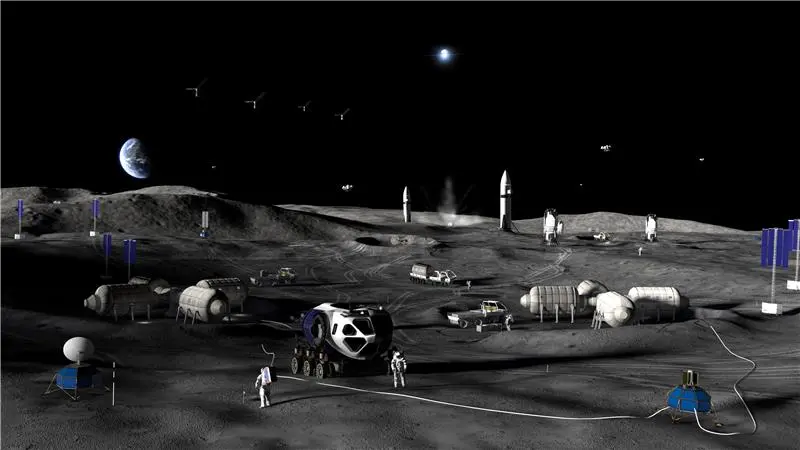
NASA released this rendering of a Moon base that will be built over the next decade.
Credit:
NASA
Garcia-Galan explained that the lunar base would be established through three phases, using a mix of providers primarily through a scaled up Commercial Lunar Payload Services program. Each of these three phases would cost on the order of $10 billion.
The first of these, running through 2028, is estimated to comprise 21 landings, putting a total of 4 metric tons of payload on the Moon, including the VIPER rover to prospect for lunar resources; four “Moon Fall” drones that can travel up to 50 km and reach areas difficult for humans to access; initial versions of a lunar terrain vehicle capable of surviving up to 150 hours without sunlight; and radioisotope heater units. During this phase NASA will also seek to establish two lunar orbital communications satellite constellations.
As part of phase two, running from 2029 to 2032, NASA will seek to secure a site for a lunar base. This phase is projected to entail 27 landings with a total mass of 60 metric tons. These landed payloads would include larger, pressurized rovers, solar and nuclear power sources for surface activities, towers for communication, and excavator rovers.
The final phase, from 2032 to 2036, will establish habitats for long-term human presence, supporting four astronauts for four-week missions. Over the course of 28 landings, NASA would seek to place 150 metric tons of payload on the surface, including fission power, multiple rovers, an “industrial neighborhood” to support in-situ manufacturing, and the capability to return hundreds of kilograms to Earth, such as scientific experiments, critical hardware, and lunar materials.
Providing focus
The Moon base will be NASA’s main exploration focus going forward. Garcia-Galan said part of his job will be bringing together the various efforts at NASA previously focused on or near the Moon and make it clear to all that the work they’re doing must be bent toward supporting a Moon base.
This is why the Commercial Lunar Payload Services program will be scaled up, to accommodate the increased need for frequent access to the Moon with larger cargoes. It’s why Gateway had to go. It’s why NASA will develop not one, but two networks of communications satellites.
With the Ignition event on Tuesday, Isaacman brought this much-needed focus to the space agency. For a long time reporters have joked that NASA stands for “Never A Straight Answer” because it wasn’t quite clear where NASA was going, or why it was doing some of the things it was doing. Now there is a clear plan for people like Garcia-Galan to go and execute.
“It’s very clear that we need to be focused on one thing, not 10 things,” he said. “So for me, this is a game-changer. It’s quite incredible.”