
“The Architect” (2009).Art work by Noah Davis / Courtesy Studio Museum in Harlem

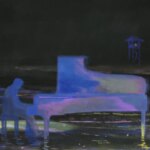

The show opens with Davis’s early work, some of which is precisely that. Looking at reproductions, I’d been eager to see “40 Acres and a Unicorn” (2007)—a twist on Reconstruction’s failed promise of “forty acres and a mule”—but, on closer inspection, its fidgety modelling of a man’s face revealed an important caveat to Davis’s skill, which is that he wasn’t a portraitist. What’s a delight, though, are the rival tendencies on display in the first room. You can see a lunge toward van Gogh in the thick, swirling brushwork of “Mary Jane” (2008), and an out-of-left-field gesture in “Nobody” (2008), where Davis does a riff on a Malevich square, in purple. Then there’s a little thunderclap of originality: “Bad Boy for Life” (2007). Squeezed into a room with candy-striped wallpaper, a woman raises her arm to strike a boy on her lap. The first thing you’ll notice is her mouth. She doesn’t have one. The body horror turns absurd when you see that the child is dressed like a naughty jockey, wearing a gold suit and leather riding boots. The painting could be about the transmission of violence across generations, but it has all of the moral weight of a circus tent. Like much of Davis’s best work, it creates ambivalence through a specific stylistic trick: arranging blurred or roughly painted figures on a crisply delineated ground. The people always seem to be both of this world and the next.
The year 2008 was a hinge in Davis’s life. He fell in love with his future wife, Karon; had his first solo exhibition, at the Roberts & Tilton gallery, in L.A.; and was the youngest painter chosen for a major exhibition of the Rubell Family Collection which featured thirty Black artists, including stars such as David Hammons, Glenn Ligon, Lorna Simpson, and Kara Walker. Davis felt uneasy about the strictures of “Black artist” as a category, but was thrilled about the invitation. “For a while, I thought I was being put in a box,” he said. “But it’s probably the most glamorous box I’ve ever been in.” Growing up in Seattle, his first eureka moment with art was seeing Walker’s cutout silhouettes. Now he was in a show with her.
By the following year, Davis had a discernible style. Playing solid blocks of color against thin or runny paint, he could turn the surface of a painting into its emotional core. In “The Architect” (2009), a portrait of the L.A. architect Paul Revere Williams, a glacier of light blue swallows Williams’s face and drips onto the model of a building, which fans out in a ziggurat of blocks and triangles. Williams was the first Black member of the American Institute of Architects; he had to learn how to draw upside down, because white clients didn’t like sitting next to him. The psychological chill sent through the painting by the drip work isn’t unlike Edvard Munch’s “The Sick Child” (1885-86), where the streaks cast over the scene imply the painter’s own tears. That’s what an active surface can do. My favorite example in the show is “The Year of the Coxswain” (2009), in which a group of rowers in singlets carry a boat across the picture plane, slicing it in two. There’s a lone trumpeter to the side, wearing a black tunic and looking like Death. Note all of the variations in texture. The boat is as dry and yellow as a crumpet, but the paint elsewhere runs in long tendrils, or swirls into the swampy alluvial ground. In Davis’s work, runny paint has a way of acquitting objects of their permanence. Here, it gives the impression that the rowers are pallbearers and the boat is a coffin. A painting of morning calisthenics turns into an elegy.