Since these objects are unlinked to any exosolar system, they’re not going to have any regular interactions with stars; our only way of spotting them is through microlensing. And microlensing tells us very little about the size of the planet. To figure things out, we would need some indication of things like how distant the star and planet are, and how big the star is.



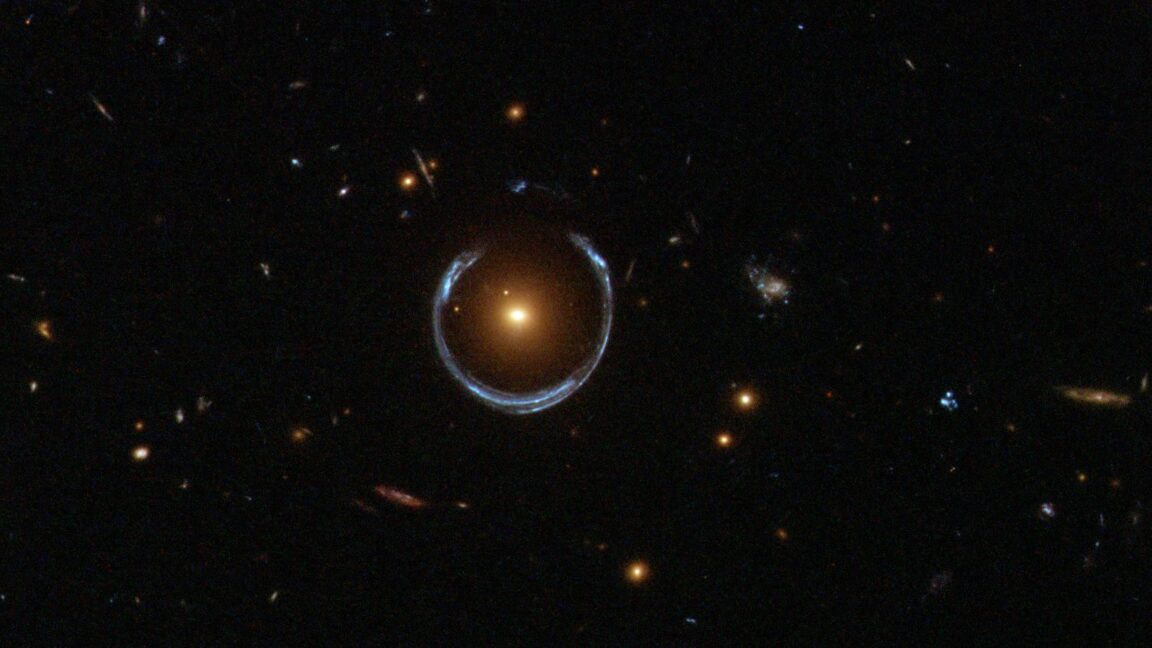
That doesn’t mean that microlensing events have told us nothing. We can identify the size of the Einstein ring, the circular ring of light that forms when the planet and star are perfectly lined up from Earth’s perspective. Given that information, and some of the remaining pieces of information mentioned above, we can figure out the planet’s mass. But even without that, we can make some inferences using statistical models.
Studies of collections of microlensing events (these collections are small, typically in the dozens, because these events are rare and hard to spot) have identified a distinctive pattern. There’s a cluster of relatively small Einstein rings that are likely to have come from relatively small planets. Then, there’s a gap, followed by a second cluster that’s likely to be made by far larger planets. The gap between the two has been termed the “Einstein desert,” and there has been considerable discussion regarding its significance and whether it’s even real or simply a product of the relatively small sample size.
Sometimes you get lucky
All of which brings us to the latest microlensing event, which was picked up by two projects that each gave it a different but equally compelling name. To the Korea Microlensing Telescope Network, the event was KMT-2024-BLG-0792. For the Optical Gravitational Lensing Experiment, or OGLE, it was OGLE-2024-BLG-0516. We’ll just call it “the microlensing event” and note that everyone agrees that it happened in early May of 2024.