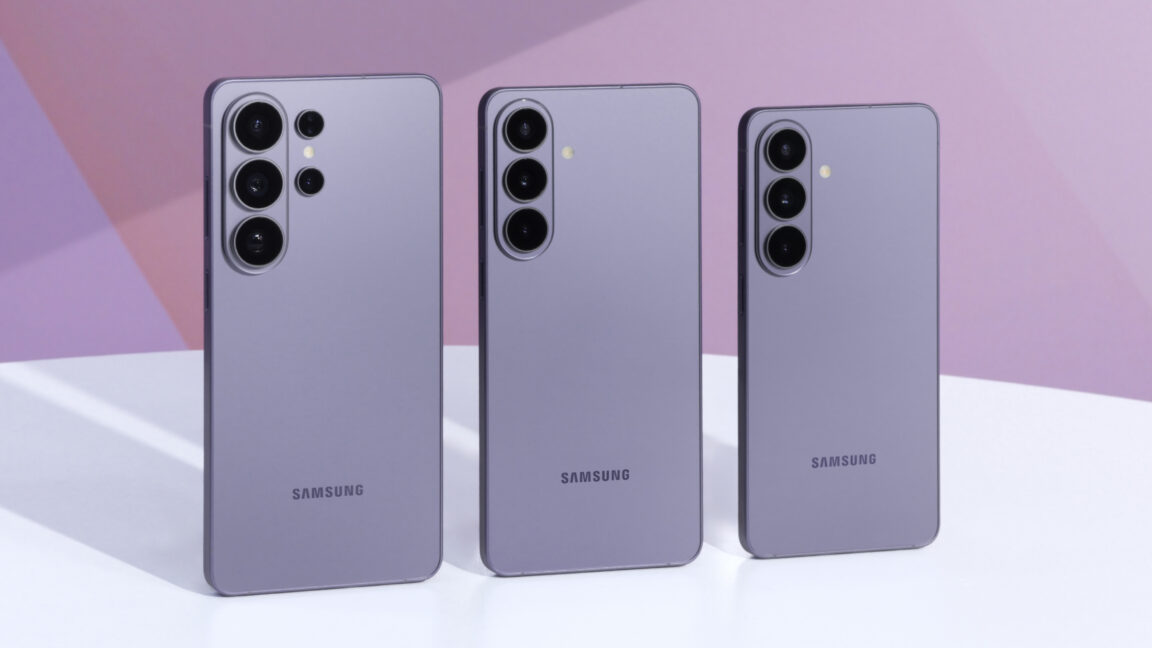
There used to be countless companies making flagship Android phones, but a combination of factors has narrowed the field over time. Today, Samsung is the undisputed king of the Android device ecosystem with its Galaxy S line. So we can safely assume today’s Unpacked has revealed the most popular Android phones for the next year—the Galaxy S26 Ultra, Galaxy S26+, and Galaxy S26.



Samsung didn’t swing for the fences this time around, producing phones with a few cosmetic tweaks and upgraded internals. Meanwhile, Samsung is investing even more in AI, saying the S26 series includes the first “Agentic AI phones.” Despite limited hardware upgrades, the realities of component prices in the age of AI mean the prices of the two cheaper models have gone up by $100 this year. The Ultra remains at an already eye-watering $1,300.
Faster and more private
Looking at the Galaxy S26 family, you’d be hard-pressed to tell them apart from last year’s phones. The camera surround is different, and the measurements of the smallest and largest phone are ever so slightly different. You probably won’t be able to tell just by looking, but the S26 Ultra has regressed from titanium to aluminum, a reversion Apple also made with its latest high-end phones. This phone also retains its S Pen stylus.
| Specs at a glance: Samsung Galaxy S26 series | |||
|---|---|---|---|
| Galaxy S26 ($900) | Galaxy S26+ ($1,100) | Galaxy S26 Ultra ($1,300) | |
| SoC | Snapdragon 8 Elite Gen 5 (3 nm) | Snapdragon 8 Elite Gen 5 (3 nm) | Snapdragon 8 Elite Gen 5 (3 nm) |
| Memory | 12GB | 12GB | 12GB, 16GB |
| Storage | 256GB, 512GB | 256GB, 512GB | 256GB, 512GB, 1TB |
| Display | 6.3-inch OLED, 10-bit color, 2340×1080, 1-120Hz | 6.7-inch OLED, 10-bit color, 3120×1440, 1-120Hz | 6.9-inch OLED, 10-bit color, 3120×1440, 1-120Hz, S Pen support |
| Cameras | 50MP primary, f/1.8, 1.0 μm; 12MP ultrawide, f/2.2, 1.4 μm, 10MP 3x telephoto, f/2.4, 1.0 μm; 12MP selfie, f/2.2, 0.7 μm | 50MP primary, f/1.8, 1.0 μm; 12MP ultrawide, f/2.2, 1.4 μm, 10MP 3x telephoto, f/2.4, 1.0 μm; 12MP selfie, f/2.2, 0.7 μm | 200MP primary, f/1.4, 0.6 μm; 50MP ultrawide, f/1.9, 0.7 μm; 10MP 3x telephoto, f/2.4, 1.12 μm; 50MP 5x telephoto, f/2.9, 0.7 μm |
| Software | Android 16 | Android 16 | Android 16 |
| Battery | 4,300 mAh | 4,900 mAh | 5,000 mAh |
| Connectivity | Wi-Fi 7, Bluetooth 5.4, USB-C 3.2, Sub6 5G | Wi-Fi 7, Bluetooth 5.4, USB-C 3.2, Sub6 and mmWave 5G | Wi-Fi 7, Bluetooth 5.4, USB-C 3.2, Sub6 and mmWave 5G |
| Measurements | 71.7×149.6×7.2 mm, 167g | 75.8×158.4×7.3 mm, 190g | 78.1×163.6×7.9 mm, 214 g |
These phones will again have the latest Snapdragon flagship processor (in North America, Japan, and China) with customizations exclusive to Samsung. The Snapdragon 8 Elite Gen 5 for Galaxy is a 3 nm chip with third-gen Oryon CPU cores, an Adreno 840 GPU, and a powerful Hexagon NPU for on-device AI processing. Samsung promises double-digit performance gains across the board, which is what we hear every year.
Samsung flagship phones have extremely fast hardware, so they benchmark well. However, they also tend to heat up and throttle quickly during sustained use. Perhaps that won’t be as much of a problem with the S26 series. Samsung says it has implemented its largest vapor chamber ever to better control temperatures.