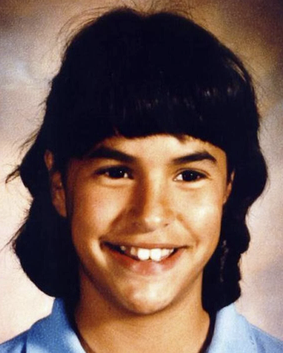
For decades, the disappearance of 12-year-old Jonelle Renee Matthews remained one of Colorado’s most haunting unsolved cases.
Jonelle vanished from her family’s home in Greeley on December 20, 1984. Her disappearance became part of the national conversation surrounding missing children, but despite years of searches and investigations, there was no answer about what had happened to her.
Then, nearly 35 years later, construction workers discovered human remains in a remote area southeast of Greeley.
DNA testing finally provided the identity investigators had been searching for: the remains belonged to Jonelle Matthews.
The discovery transformed a decades-old missing-person case into a homicide investigation—and eventually led investigators to Steven Pankey.
A Young Girl Growing Up in Colorado
Jonelle Matthews was born on February 9, 1972, in Santa Barbara, California.
Her biological mother, Terri Vierra, was only 13 years old when Jonelle was born. Six weeks later, Jonelle was adopted by Jim and Gloria Matthews, who were already raising a daughter.
The family eventually moved to Greeley, Colorado, where Jonelle grew up with her adoptive parents and older sister.
Jim Matthews later became the principal of Platte Valley Elementary School in Kersey, Colorado.
By the age of 12, Jonelle was a student at Franklin Middle School and participated in the school’s choir.
The Night Jonelle Disappeared
December 20, 1984, began like an ordinary winter day.
That evening, Jonelle performed in a Christmas concert with her school choir at IntraWest Bank of Denver.
Her father was attending her older sister’s basketball game, while her mother was temporarily out of state helping care for an ill family member.
After the concert, Jonelle received a ride home from her friend Deanna and Deanna’s father, Russ Ross.
She arrived at the Matthews residence at approximately 8:15 p.m.
Around 8:30, she answered a telephone call and took a message for her father.
It would become the last confirmed conversation Jonelle had with anyone other than the person investigators believe abducted her.
An Empty House
Jim Matthews returned home at about 9:30 p.m.
Something immediately seemed wrong.
The garage door was open, but Jonelle was nowhere inside the house.
Her shoes and shawl were near a heater in the family room, a spot where she frequently spent time. Because there was snow outside, her father found it difficult to believe that she would simply leave the house without putting on her shoes.
Jonelle’s older sister returned around 10 p.m. and also had no idea where she was.
Police were called.
When officers arrived at approximately 10:15 p.m., they noticed footprints in the snow outside the residence. The tracks suggested that someone had been looking through the home’s windows.
There was no obvious evidence of forced entry and no clear sign of a struggle inside.
But Jonelle was gone.
A Search That Reached Across America
The investigation quickly expanded.
Jonelle became one of the children whose photograph appeared on milk cartons during the nationwide campaign to locate missing children.
Her disappearance also received attention from government officials. President Ronald Reagan mentioned Jonelle during a March 1985 speech, and her case was later recorded in the Congressional Record.
Investigators continued looking for leads while Jonelle’s family waited for answers.
A memorial tree was eventually planted outside Franklin Middle School in her honor. The tree later died, and the plaque bearing her name also disappeared.
The years passed without solving the mystery.
Her Birth Mother Was Looking for Her Too
Jonelle’s biological mother, Terri Vierra-Martinez, spent years trying to locate the daughter she had placed for adoption.
At one point, investigators had placed Vierra under surveillance without informing her that Jonelle was missing.
In 1994, Jonelle was legally declared dead.
Three years later, Vierra contacted Gloria Matthews after using a search consultant to locate the child she had given up for adoption.
The Matthews family had to tell her the devastating truth: Jonelle had disappeared more than a decade earlier.
Over time, the two families became friends.
The Case Refuses to Go Away
Jonelle’s disappearance remained open even as technology changed.
In later years, investigators began revisiting old information and contacting people connected to the original investigation. Modern forensic techniques offered possibilities that had not existed in 1984.
Then came the breakthrough.
Human Remains Are Found
On July 23, 2019, construction workers were installing a pipeline near the intersection of County Roads 34.5 and 49.
At approximately 4:50 p.m., they discovered human remains.
The location was roughly 15 miles southeast of the Matthews family’s former home.
Investigators began examining the remains, and DNA testing ultimately confirmed what authorities had hoped and feared:
The remains were Jonelle Matthews.
She had been missing for nearly 35 years.
The forensic examination determined that she had died from a gunshot wound to the head.
For Jonelle’s family, the discovery finally answered the question of whether she was still alive—but it also confirmed that her disappearance had ended in murder.
Investigators Turn Their Attention to Steven Pankey
Two months after the discovery, authorities publicly identified Steven Dana Pankey as a person of interest.
Pankey had previously lived in Greeley and, at the time Jonelle disappeared, lived only a few miles from the Matthews home.
He had also been a youth pastor at the church attended by the Matthews family.
On September 4, 2019, police searched Pankey’s condominium in Twin Falls, Idaho, under a warrant.
Investigators said they had probable cause to believe he had been involved in Jonelle’s abduction and death.
Pankey denied knowing Jonelle or her family.
He said he had only learned about the girl after her disappearance became public.
His Changing Statements Drew Attention
Over the years, Pankey repeatedly inserted himself into discussions surrounding Jonelle’s case.
According to investigators, some of his statements became increasingly concerning.
He claimed to know details about the crime and at one point sought immunity in exchange for information.
He also reportedly told investigators that a rake had been used to obscure tracks in the snow around the time Jonelle disappeared.
His former wife, Angela Hicks, provided investigators with additional information about their activities during the period.
She said their planned Christmas trip to California did not begin until December 22, two days after Jonelle vanished.
According to Hicks, Pankey showed an unusual interest in news reports about Jonelle after they returned. She also recalled him making statements that connected their family’s later tragedy with Jonelle’s disappearance.
Investigators examined these statements alongside other evidence gathered during the renewed investigation.
The Case Finally Reaches Court
In October 2020, Pankey was indicted on charges connected to Jonelle’s kidnapping and murder.
He was 69 years old at the time.
After being extradited from Idaho to Colorado, he appeared in court in Greeley.
Jonelle’s sister, Jennifer Mogensen, later described the arrest as providing her family with a measure of closure. For relatives who had spent decades wondering what happened, the prosecution represented a major development in a case that had once seemed impossible to solve.
The First Trial Ends Without a Verdict
Pankey’s first trial began in October 2021.
The prosecution argued that his conduct, statements and behavior over the years pointed toward his involvement in Jonelle’s disappearance and death.
The defense offered a different explanation, arguing that his intense interest in the case did not prove that he had committed the crime.
After weeks of testimony, the jury could not reach a unanimous decision on the murder and kidnapping charges.
A mistrial was declared in November 2021.
The jury did, however, convict Pankey on a misdemeanor charge involving false statements to police.
The major questions remained unanswered.
A Second Trial Brings a Conviction
Pankey was tried again in 2022.
This time, a Weld County jury found him guilty of kidnapping and murdering Jonelle Matthews on October 31.
He was sentenced to 20 years to life in prison.
Pankey continued to maintain that he was innocent and indicated that he intended to challenge the conviction.
His earliest possible release date would come decades later, when he would be in his nineties.
As of 2025, he was serving his sentence at the Arkansas Valley Correctional Facility in Colorado.
A Case That Changed the Way America Saw Missing Children
Jonelle Matthews’ photograph became familiar to millions of Americans during the 1980s.
Her case emerged during an era when missing children’s photographs were increasingly distributed through milk cartons, newspapers and national media.
Her disappearance also demonstrated how difficult it could be for investigators to solve a crime when crucial evidence remained undiscovered for decades.
For Jonelle’s family, however, the case was never simply a historical mystery.
She was a daughter.
She was a sister.
She was a 12-year-old girl who went home after a Christmas concert and never came back.
Decades Later, Some Answers Finally Arrived
Jonelle disappeared in December 1984.
Her remains were discovered in July 2019.
More than three decades separated those two events.
The long investigation shows how a case can remain dormant without truly being forgotten. New forensic technology, renewed investigative work and information gathered over the years eventually brought Jonelle’s name back into the center of the investigation.
Her story has since been examined in several television productions, including episodes of 48 Hours, Dateline and other true-crime programs.
But beyond documentaries and headlines, Jonelle Matthews remains remembered as a child whose life was taken far too soon—and whose family waited decades for answers.
Her disappearance began as a mystery in a snowy Colorado town.
It ended with a discovery in an isolated field nearly 35 years later.
And for her loved ones, that discovery finally gave a name to the tragedy they had carried with them for generations.
This story is based on publicly available information and reported facts. It has been independently written and presented for informational purposes. Images, if any, belong to their respective owners.