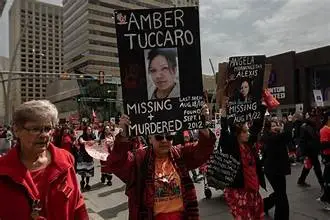
SHE GOT INTO A STRANGER’S CAR. SHE NEVER CAME BACK.
Alberta, Canada — August 18, 2010
Twenty-year-old Amber Alyssa Tuccaro had traveled from Fort McMurray to the Edmonton area for what was supposed to be a short getaway.
She had her fourteen-month-old son with her.
She was traveling with a female friend.
And within a day, Amber would disappear.
The last known person to see her alive was a man whose identity remains unknown.
What happened during that final ride was partially captured on a phone call—and years later, that recording would become one of the most important pieces of evidence in the case.
But Amber’s family would also spend years questioning how her disappearance was handled from the very beginning.
Her remains were eventually found in a rural field.
The man heard on that recording has never been publicly identified.
And Amber’s case remains unsolved.
WHO WAS AMBER TUCCARO?
Amber Alyssa Tuccaro was born in Alberta on January 3, 1990.
She was a member of the Mikisew Cree First Nation.
At the time she disappeared, Amber was living in Fort McMurray with her mother and her fourteen-month-old son.
She was only twenty years old.
For Amber, the trip to the Edmonton area was supposed to be temporary.
On August 17, 2010, she traveled by plane from Fort McMurray to Edmonton with her young son and a female friend.
The group stayed at a hotel in Nisku, a community near Edmonton.
The following evening, Amber left the hotel.
She would never return.
THE LAST RIDE
On August 18, Amber was last seen at approximately 8 p.m.
She had accepted a ride into Edmonton from an unidentified man.
At first, there was nothing about the ride that suggested what was about to happen.
But during the journey, Amber received a phone call.
The conversation was recorded.
The man driving the vehicle could be heard speaking in the background.
He told Amber that they were traveling east along a back road toward Edmonton.
Investigators later believed that wasn’t where they were actually going.
According to police, the vehicle was instead traveling south into rural Leduc County.
At some point during the conversation, Amber became concerned about where the man was taking her.
Then she said something that would become one of the most haunting pieces of evidence in the investigation:
“You’d better not be taking me anywhere I don’t want to go.”
After that night, Amber disappeared.
A VOICE WITHOUT A NAME
The recording remained in the possession of investigators.
For years, the identity of the man speaking to Amber was unknown.
In 2012, police released the audio publicly, hoping someone would recognize his voice.
It was an unusual piece of evidence.
There was no clear photograph of the man.
No confirmed name.
No known identity.
Only a recording of a conversation between a young woman and the unknown driver who had picked her up.
Investigators appealed to the public for anyone who might recognize the voice.
That recording remains central to the case.
TWO YEARS LATER, AMBER WAS FOUND
For more than two years, Amber’s family lived without knowing where she was.
Then, on September 1, 2012, horseback riders discovered human remains in a field in Leduc County.
The remains were later identified as Amber Tuccaro through dental records.
The discovery confirmed what her family had feared.
Amber had not simply disappeared.
She was dead.
But the discovery did not provide the answer they had been waiting for.
Who killed Amber?
And who was the man driving the vehicle that night?
Those questions remain unanswered.
A FAMILY THAT FELT THEY WEREN’T BEING HEARD
Amber’s disappearance had already been deeply painful for her family.
But they would later raise serious concerns about the way the investigation was handled.
In September 2010, shortly after Amber disappeared, the RCMP publicly stated that investigators did not believe she was in danger.
Amber’s family strongly disagreed with the way her disappearance was being treated.
They believed their concerns were not being taken seriously enough.
They also questioned whether stereotypes surrounding Indigenous women influenced how authorities viewed Amber’s disappearance.
Years later, an independent review would examine those concerns.
And its findings would be highly critical.
THE INVESTIGATION UNDER SCRUTINY
In 2014, Amber’s family filed a complaint with the Civilian Review and Complaints Commission for the RCMP.
The commission conducted an independent review of the investigation.
Its 120-page report was released in August 2018.
The findings were stark.
The commission concluded that the RCMP investigation had been “deficient”, citing failures involving training, procedures, and investigative guidelines.
The review found that investigators did not begin investigating Amber’s disappearance until approximately a month after she had been reported missing.
According to the report, family members had initially been told that Amber was probably out partying and that they needed to wait twenty-four hours before a missing-person investigation could begin.
The commission also found that it took approximately four months before investigators conducted interviews in connection with the disappearance.
The report described that delay as unreasonable and unexplained.
AMBER WAS REMOVED FROM THE MISSING-PERSON DATABASE
There was another major problem.
Amber had initially been entered into the missing-person system.
But she was later removed after investigators received alleged sightings that had not been confirmed.
On September 23, 2010, Amber was placed back on the missing-person list.
The commission later described the earlier removal as an “erroneous decision.”
For Amber’s family, the decision was another painful reminder of what they believed had gone wrong.
They had been trying to get authorities to understand that Amber was missing.
Yet her disappearance was initially treated as though she might simply have chosen not to return.
THE WOMAN WHO TRAVELED WITH AMBER
The independent review also criticized investigators for failing to properly contact and interview the woman who had traveled with Amber from Fort McMurray to Edmonton.
Her identity was redacted in the commission’s report.
According to the review, she was never considered a person of interest.
The omission was significant because she had been with Amber during the trip immediately preceding her disappearance.
Yet investigators did not properly interview her as part of the early investigation.
A SUITCASE WAS DESTROYED
Another investigative failure involved Amber’s belongings.
After she disappeared, investigators recovered a suitcase containing her possessions from the motel room in Nisku.
But the suitcase was accidentally destroyed.
The commission concluded that two members of the Leduc RCMP detachment had failed to properly follow policy and reasonable investigative practices concerning seized property.
For a family already desperate for answers, the loss of potential evidence was devastating.
THE APOLOGY
The commission’s findings did not end the matter.
On July 25, 2019—nearly a year after the report was released—RCMP Deputy Commissioner Curtis Zablocki apologized to Amber’s family.
He acknowledged that the investigation had not represented the RCMP’s best work.
But Amber’s family rejected the apology.
For them, the issue was not simply whether police eventually acknowledged mistakes.
It was what those mistakes may have meant during the crucial early days after Amber disappeared.
A CASE THAT REMAINS UNSOLVED
Amber’s remains were found in 2012.
The recording of her final known ride was eventually released.
The RCMP investigation was independently reviewed.
And serious deficiencies were identified.
But one crucial piece is still missing.
The identity of the man whose voice is heard on the recording.
He was the last known person to be with Amber.
Investigators believe the vehicle traveled into rural Leduc County rather than toward Edmonton as Amber had been told.
And Amber’s remains were ultimately discovered in that same general rural area.
Yet the person responsible for her death has not been identified.
AMBER’S VOICE IS STILL WAITING TO BE RECOGNIZED
More than a decade after Amber disappeared, her voice can still be heard on the recording from that final journey.
She sounds uncertain.
She knows something about the situation isn’t right.
And she asks the man driving her not to take her somewhere she doesn’t want to go.
Those words became part of the evidence in a case that has never been solved.
Amber was twenty years old.
She was a mother.
She was a daughter.
She was a member of the Mikisew Cree First Nation.
And she should have been able to return home from a short trip with her young son.
Instead, she vanished.
Two years later, her remains were found in a rural field.
The man who drove her that night remains unidentified.
And for Amber’s family, the search for answers continues.
This story is based on publicly available information and reported facts. It has been independently written and presented for informational purposes. Images, if any, belong to their respective owners.