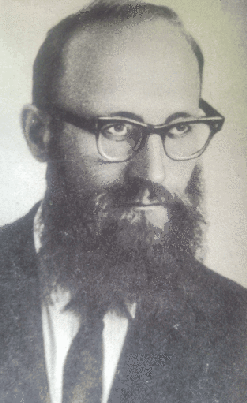
Podolsk, Russia — March 2000
William August Vasilyevich Pokhlyobkin was a man whose interests seemed to stretch across several worlds.
He was a historian, a scholar of Scandinavian affairs, a journalist, a writer, and one of the best-known authorities on the history of Russian cuisine.
He wrote dozens of books and hundreds of articles.
His work reached readers in countries around the world.
But in the spring of 2000, the life of the 76-year-old scholar came to a violent end inside his apartment in Podolsk.
Pokhlyobkin was murdered.
More than two decades later, the circumstances surrounding his death remain unresolved.
A NAME WITH A STRANGE HISTORY
William Pokhlyobkin was born on August 20, 1923.
His father was Vasili Mikhailov, a Russian revolutionary who used “Pokhlyobkin” as an underground nickname. The unusual surname came from the Russian word pokhlyobka, referring to a type of vegetable soup.
Even William’s first name has several explanations.
Some accounts say he was named after William Shakespeare. Others suggest that “Vil-August” was connected to Vladimir Lenin and August Bebel, while another explanation is simply that he was born in August.
Whatever the origin, his family reportedly called him simply William.
FROM WAR TO HISTORY
Pokhlyobkin lived through some of the most turbulent years of twentieth-century Russian history.
He served as a private during both the Soviet-Finnish War and the German-Soviet War.
Early in the Second World War, he suffered a concussion and was later reassigned to work involving food preparation.
That experience would eventually intersect with an entirely different part of his life.
After leaving military service, Pokhlyobkin pursued an academic career.
From 1945 to 1949, he studied at the Moscow State Institute of International Relations, concentrating on Scandinavia and Yugoslavia.
He later completed postgraduate studies at the Institute of History of the USSR Academy of Sciences.
By 1953, he had earned the degree of Kandidat of Historical Sciences and had joined the Institute of History as a researcher.
THE HISTORIAN WHO COULD NOT STAY OUT OF CONTROVERSY
Pokhlyobkin’s academic interests were broad.
He studied Scandinavian history, diplomacy, international relations, heraldry, and geography.
In 1955, he founded the journal Skandinavskii sbornik and became its chief editor, a position he held until 1961.
He later served on the editorial board of Scandinavica.
But his academic career did not progress as smoothly as his reputation might suggest.
According to accounts from Pokhlyobkin and people who knew him at the Institute, his difficult relationships with colleagues and supervisors repeatedly created problems.
He never completed his doctoral dissertation and eventually left the Institute.
That departure pushed him toward another subject that would make him internationally known:
food.
THE WRITER OF RUSSIAN CUISINE
In 1968, Pokhlyobkin published his first major book about food, Tea: Its Properties, Types, and Use.
The book was presented as politically neutral, yet it became popular among dissidents.
That attention reportedly brought unwanted scrutiny.
The KGB-affiliated newspaper Socialist Industry published negative coverage of the work. Afterward, Pokhlyobkin was reportedly prevented from publishing and lost access to historical archives.
He continued writing.
Over the following decades, his work expanded into the history and culture of food, and he eventually became one of the most prolific culinary writers associated with Russian cuisine.
By the time of his death, 54 books and more than 400 articles had been published under his name.
His selected works were eventually collected into six volumes.
His books were translated into numerous languages, including English, German, Portuguese, Dutch, Scandinavian languages, Polish, Hungarian, and Chinese.
THE BOOK ABOUT VODKA
Among Pokhlyobkin’s most famous works was A History of Vodka.
The book gained international recognition and was honored in 1993 with the Langhe Ceretto Prize, with Pokhlyobkin’s work receiving recognition in the alcoholic-beverages category.
But the book later became controversial.
Critics questioned a number of its historical claims. In particular, historian and political scientist Mark Schrad argued in 2014 that substantial portions of the book’s history were likely fabricated.
One disputed example involved Pokhlyobkin’s claim that the Soviet Union and Poland had engaged in a trademark dispute over the exclusive use of the word “vodka.”
According to the later criticism, no evidence of such a dispute could be found.
Other sources cited in the book also proved difficult to verify.
The debate over his historical work did not erase his influence as a culinary writer, but it added another complicated layer to the legacy he left behind.
THE LAST DAYS OF WILLIAM POKHLYOBKIN
Then, in March 2000, something happened inside Pokhlyobkin’s apartment in Podolsk.
He was believed to have been killed sometime between March 27 and March 31.
The attack was brutal.
Pokhlyobkin had been stabbed eleven times with a screwdriver.
There was another detail that investigators found particularly unusual.
Alcohol was discovered in his system.
That stood out because Pokhlyobkin was known as a teetotaler.
Who had been with him?
Why was alcohol present?
And what had happened inside the apartment?
Those questions have never been fully answered.
A BODY DISCOVERED WEEKS LATER
Pokhlyobkin’s body was not discovered immediately.
Nearly two weeks later, on April 13, the chief editor of the Polyfakt publishing house traveled from Moscow to Podolsk.
He had become concerned because Pokhlyobkin was late with the book Cuisine of the Century.
The editor arrived expecting to meet the author.
Instead, he discovered that Pokhlyobkin was dead.
By then, the 76-year-old historian had already been gone for days.
A MURDER WITHOUT A SOLUTION
The killing shocked those who knew Pokhlyobkin and left behind a mystery that has never been conclusively resolved.
Why was a respected scholar and prolific writer attacked in his own home?
Was the murder connected to his professional work?
Was it personal?
Was there another motive entirely?
The available account does not provide a confirmed answer.
A large body of Pokhlyobkin’s work on Scandinavian subjects also remained unpublished after his death, leaving unfinished projects behind.
THE LEGACY HE LEFT BEHIND
William Pokhlyobkin lived several different lives in one.
He was a wartime soldier who became a historian.
A scholar of international relations who eventually turned toward food.
A prolific author whose books were read far beyond Russia.
And a controversial historian whose claims continue to be debated.
But his final chapter is defined by something much darker.
In March 2000, William Pokhlyobkin was murdered inside his apartment in Podolsk.
His body was discovered on April 13.
The weapon, the circumstances, and the unanswered questions surrounding his final days remain part of a case that has never been solved.
For a man who spent his life documenting the history of other people and cultures, his own death became a mystery that history has yet to explain.
This story is based on publicly available information and reported facts. It has been independently written and presented for informational purposes. Images, if any, belong to their respective owners.