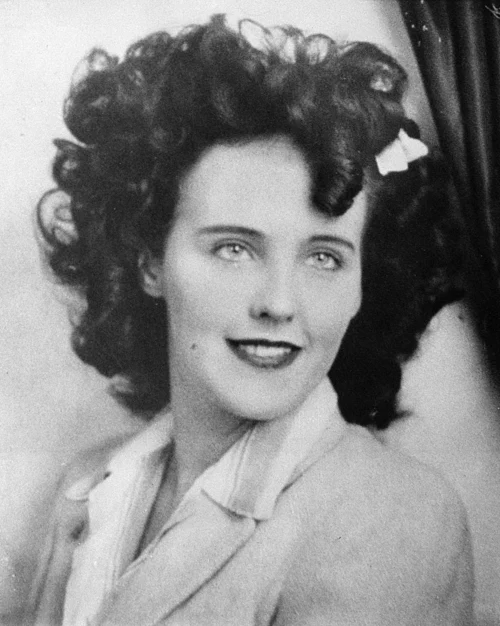
On January 15, 1947, the body of 22-year-old Elizabeth Short was discovered in an undeveloped area of Los Angeles. The shocking condition in which she was found transformed the case into one of the most notorious unsolved murders in American history.
Newspapers soon gave Short a name that would become permanently associated with the case: the Black Dahlia.
More than seven decades later, Elizabeth Short’s murder remains officially unsolved. Numerous suspects have been investigated, hundreds of people have confessed, and countless theories have emerged—but no one has ever been convicted of killing her.
Elizabeth Short’s Early Life
Elizabeth Short was born on July 29, 1924, in Boston, Massachusetts. She was the third of five daughters born to Cleo Alvin Short Jr. and Phoebe May Sawyer.
Her family eventually settled in Medford, Massachusetts, after briefly living in Portland, Maine.
Elizabeth’s childhood was affected by financial hardship. Her father had been involved in building miniature golf courses, but much of the family’s money disappeared during the stock market crash of 1929.
The following year, his abandoned automobile was discovered on the Charlestown Bridge. Because he was presumed to have taken his own life, Elizabeth’s mother began supporting the family herself.
Years later, the family learned that Cleo Short was actually alive.
Health Problems and a New Life in California
Elizabeth suffered from serious respiratory problems, including asthma and bronchitis. At 15, she underwent lung surgery, and doctors recommended that she spend time in warmer climates.
She spent several winters in Florida and eventually left high school before completing her sophomore year.
In late 1942, her mother received a letter from Cleo, revealing that he was alive and living in California.
At 18, Elizabeth traveled to Vallejo, California, hoping to live with her father. Their reunion did not last long. Following disagreements between them, she left the household in early 1943.
She found work at a military base near Lompoc and later moved to Santa Barbara. Her life there was unstable, and she was arrested in September 1943 for drinking while underage.
Although juvenile authorities sent her back to Massachusetts, Elizabeth eventually returned to Florida.
A Lost Engagement
While in Florida, Elizabeth met Major Matthew Michael Gordon Jr., a decorated Army Air Forces officer.
According to Elizabeth, Gordon proposed marriage while recovering from injuries sustained in a plane crash in India. She accepted.
The relationship, however, never reached marriage.
Gordon died in another aircraft accident on August 10, 1945.
His death was reportedly devastating to Elizabeth, and she continued moving between different places before eventually making her way back to California.
Her Final Months in Los Angeles
Elizabeth arrived in Los Angeles in July 1946.
She spent the final six months of her life mainly in Southern California. During this period, she worked as a waitress and rented a room behind the Florentine Gardens nightclub on Hollywood Boulevard.
Later accounts frequently portrayed her as an aspiring actress. Although she may have dreamed of becoming a film star, there is no confirmed record of her having worked as an actress or receiving acting credits.
Her personal life, friendships, and movements during this period later became the subject of intense speculation.
Some stories circulated about her that were never firmly established, making it difficult to separate Elizabeth’s actual history from the mythology that developed after her death.
The Last Known Days
On January 9, 1947, Elizabeth returned to Los Angeles after traveling to San Diego with Robert “Red” Manley, a 25-year-old salesman with whom she had been dating.
Manley said he left her at the Biltmore Hotel in downtown Los Angeles. According to his account, Elizabeth expected to meet one of her sisters there.
There were reports that she was later seen in the area, including at the Crown Grill Cocktail Lounge.
After that, the trail became uncertain.
Elizabeth’s movements between January 9 and the discovery of her body remain one of the most important unanswered parts of the case.
The Discovery
On the morning of January 15, 1947, Elizabeth Short was found dead in a vacant lot in the Leimert Park area of Los Angeles.
The condition of her body immediately indicated that investigators were dealing with an exceptionally violent homicide.
Medical examiners estimated that she had died roughly ten hours before she was discovered, placing her death somewhere between the evening of January 14 and the early hours of January 15.
Investigators also found evidence around the location that they hoped would help identify the person responsible, including a shoe impression, tire tracks and a cement bag containing blood.
But the crime scene ultimately provided few answers.
What the Autopsy Revealed
An autopsy was performed on January 16 by Los Angeles County coroner Frederick Newbarr.
The examination documented extensive injuries and established that Elizabeth had suffered severe trauma before her death.
Investigators determined that she had sustained injuries to her head and face, and the medical evidence indicated that the fatal injuries involved hemorrhaging and shock caused by the assault.
There was also evidence that suggested possible sexual assault, although testing did not find sperm.
One of the most unusual aspects of the case was the highly precise manner in which her body had been separated. Investigators believed the technique required considerable anatomical knowledge, leading them to consider whether the murderer might have had medical training.
How Police Identified Her
At first, investigators did not know who the victim was.
Her fingerprints were sent to the FBI, where they were matched to records from a 1943 arrest.
That identification confirmed that the victim was Elizabeth Short.
The news was then delivered to her mother, Phoebe.
Reporters from the Los Angeles Examiner contacted Phoebe in Boston. In an unethical attempt to obtain information before competitors, they initially told her that Elizabeth had won a beauty contest.
Only after gathering personal details did they tell her the truth: her daughter had been murdered.
Phoebe initially refused to believe the news until local authorities confirmed Elizabeth’s death.
The Birth of the “Black Dahlia”
The murder quickly became a national media sensation.
Newspapers published dramatic descriptions of Elizabeth and her lifestyle, often mixing confirmed information with rumor and speculation.
She was eventually given the nickname “Black Dahlia.”
The exact origin of the name has been disputed for decades. Some accounts connect it with the 1946 film The Blue Dahlia, while other reports say the nickname was already being used during Elizabeth’s lifetime.
Some investigators and historians have credited newspaper reporters with popularizing the name after her death.
Whatever its precise origin, “Black Dahlia” soon became inseparable from Elizabeth Short’s identity in the public imagination.
A Killer Who Contacted the Newspapers
Only days after Elizabeth’s body was discovered, someone claiming to be her killer contacted the Los Angeles Examiner.
The caller indicated that more material connected to Elizabeth would be sent to the newspaper.
On January 24, an envelope arrived containing personal items and documents associated with Elizabeth.
The material had apparently been cleaned with gasoline, which made investigators wonder whether the sender was actually connected to the murder.
Partial fingerprints were recovered, but they were damaged during handling and could not provide a reliable identification.
Elizabeth’s handbag and a shoe were also found separately. Those items had likewise been treated with gasoline, further complicating the forensic investigation.
More Messages, More Confusion
The supposed killer continued communicating with newspapers.
Another message promised that the murderer would surrender to police on January 29.
Authorities waited at the location mentioned in the message.
Nobody appeared.
Later, another letter arrived claiming that the writer had changed his mind.
These communications created enormous publicity but failed to produce a confirmed identification.
In March, a note was discovered among men’s clothing near the beach in Venice. The writer claimed responsibility for Elizabeth’s murder and suggested that the person responsible was too frightened to surrender.
Investigators could not establish who had left the note.
Mark Hansen Becomes a Suspect
One name that attracted particular attention was Mark Hansen, a wealthy nightclub and theater owner who knew Elizabeth.
An address book bearing Hansen’s name had been included in the material mailed to the Examiner.
Elizabeth’s friend and roommate, Ann Toth, reportedly told investigators that Elizabeth had rejected advances from Hansen. This led investigators to consider whether there might have been a motive.
Despite the suspicion surrounding him, Hansen was eventually cleared.
He was far from the only person examined.
One of Los Angeles’ Largest Investigations
The LAPD interviewed more than 150 men who were considered possible suspects.
Robert Manley, one of the last known people to spend time with Elizabeth, was also investigated. After undergoing several polygraph examinations, he was cleared.
Other people connected to Elizabeth were questioned as detectives attempted to reconstruct her final movements.
The investigation became enormous.
Approximately 750 investigators from the LAPD and other law-enforcement agencies participated during the early stages. Officers searched storm drains, abandoned properties and areas around the Los Angeles River.
A $10,000 reward was also offered for information that could lead to the killer.
Instead of producing a breakthrough, the reward attracted numerous false confessions.
Some people even falsely claimed responsibility for the murder and were later charged with interfering with the investigation.
The Investigation Goes Cold
By February 1947, investigators were struggling to find meaningful new evidence.
Captain Jack Donahue believed Elizabeth may have been killed somewhere other than the location where her body was discovered and then transported there.
Because of the precision involved in the cutting of the body, detectives also considered the possibility that the killer possessed medical or surgical knowledge.
The LAPD investigated students at the University of Southern California medical school, but nothing came from that inquiry.
By spring, the case had effectively become a cold case.
A later grand jury investigation in 1949 examined weaknesses within the LAPD’s homicide division, particularly its inability to solve several murders involving women and children.
Investigators continued looking into Elizabeth’s history and retracing her movements across different states, but those efforts did not reveal who killed her.
Hundreds of Confessions
Elizabeth Short’s murder became so famous that people continued confessing to it for generations.
Police received about 60 confessions during the original investigation.
Over the following decades, the number grew to more than 500.
Some confessions were obviously impossible because the people making them had not even been alive when Elizabeth was murdered.
Former LAPD detective John P. St. John later commented on how frequently people attempted to blame relatives for the crime.
The sheer number of false confessions became another obstacle in understanding what really happened.
The Long List of Suspects
Over the years, investigators, journalists and independent researchers have proposed numerous possible killers.
Among the names associated with different theories are Mark Hansen, Leslie Dillon, Walter Bayley, Joseph A. Dumais, Artie Lane, Francis E. Sweeney, George Hodel, Fred Sexton, George Knowlton, Robert Manley, Patrick O’Reilly and Jack Anderson Wilson.
Not every person named in books or documentaries was ever an official suspect.
For example, later claims sometimes connected figures such as Bugsy Siegel or Orson Welles to the case, but they were not suspects in Elizabeth’s murder according to the available record.
This distinction is important because the Black Dahlia case has accumulated decades of speculation, and many theories have been repeated so often that they can sound like established facts.
The George Hodel Theory
One of the most famous modern theories centers on George Hodel.
Hodel was never charged with Elizabeth’s murder.
After Hodel’s death, his son Steve Hodel argued that his father was responsible. He pointed to his father’s medical background and other circumstantial evidence.
The theory received additional attention when records from a 1949 grand jury investigation became public. They included information from a police wiretap in which George Hodel reportedly made disturbing comments that appeared to reference the Black Dahlia murder.
Even so, the evidence never resulted in a murder conviction against Hodel.
The theory therefore remains exactly that—a theory.
Another Family Claim
In the early 1990s, Janice Knowlton claimed that she had witnessed her father, George Knowlton, kill Elizabeth.
She later published a book describing her allegations.
Her claims were strongly challenged by members of her family and by investigators who had worked on the case. Detective John St. John said that her account did not fit important facts established during the original investigation.
No charges were brought against George Knowlton for Elizabeth’s murder.
The Leslie Dillon Theory
Another theory received renewed attention through Piu Eatwell’s 2017 book Black Dahlia, Red Rose.
The book focused heavily on Leslie Dillon, along with Mark Hansen, Jeff Connors and detective Finis Brown.
Eatwell proposed that Elizabeth may have discovered information about a criminal scheme and was killed because of what she knew.
The theory also placed significance on the Aster Motel.
However, competing researchers have disputed parts of this account. Larry Harnisch, for example, has argued that police thoroughly investigated Dillon and that records placed him in San Francisco around the time of Elizabeth’s death.
As with the other major theories, there has been no definitive evidence establishing Dillon as Elizabeth’s killer.
Was the Murder Connected to Other Cases?
The unusual nature of Elizabeth’s death has led researchers to compare it with several other unsolved or notorious murders.
The Cleveland Torso Murders
Some writers and investigators have proposed a connection between Elizabeth’s murder and the Cleveland Torso Murders of the 1930s.
The LAPD examined that possibility in 1947 but ultimately rejected a confirmed connection.
Later investigators again considered Jack Anderson Wilson, a former suspect in the Cleveland crimes. Wilson died in a fire in 1982 before investigators could establish whether he had any role in Elizabeth’s murder.
The theory gained renewed public attention after appearing on Unsolved Mysteries.
The Suzanne Degnan Murder
Another proposed connection involves the 1946 murder of six-year-old Suzanne Degnan in Chicago.
Some researchers pointed to similarities involving the treatment of the victims and certain written messages.
William Heirens was convicted of Degnan’s murder and spent the remainder of his life in prison. He later maintained that his confession had been coerced.
Whether his case had anything to do with Elizabeth Short remains unproven.
The “Lone Woman” Murders
Elizabeth’s murder was also examined alongside a series of killings involving women in Los Angeles between 1943 and 1949.
More than a dozen cases were considered potentially similar enough that authorities wondered whether a single unidentified killer could have been responsible for some of them.
Among the victims were Ora Elizabeth Murray, Georgette Bauerdorf, Jeanne French, Evelyn Winters, Dorothy Montgomery, Laura Trelstad and several others.
However, no serial killer was definitively linked to all of these cases.
Some proposed connections were later challenged, demonstrating how easily similarities between separate crimes could become the foundation for speculation.
Rumors vs. What Is Actually Known
Elizabeth’s personal life became almost as heavily debated as the murder itself.
Over the years, claims appeared describing her as a prostitute, a call girl, lesbian, pregnant woman, or someone unable to have normal sexual relationships.
Many of these stories were never supported by reliable evidence.
Contemporary investigations did not establish that Elizabeth had been a prostitute.
The official autopsy also contradicted some of the pregnancy-related rumors.
Likewise, several dramatic stories about what happened to her before death have no support in the official medical record.
The Black Dahlia case is a good example of how sensational journalism can blur the line between evidence and mythology.
A Mystery That Refuses to Disappear
Elizabeth Short’s murder has remained unsolved since 1947.
Her killer has never been conclusively identified, despite an enormous investigation, hundreds of confessions, numerous suspects and decades of independent research.
The case became famous not only because of the brutality of the crime but also because of everything investigators never managed to answer:
Who was the last person to see Elizabeth alive?
Where was she during her final days?
Who killed her?
And why?
Those questions remain unanswered.
Elizabeth was buried at Mountain View Cemetery in Oakland, California. Her mother, Phoebe, later moved to Oakland to live closer to her daughter’s grave.
The murder also had an impact beyond the investigation itself. Only weeks after Elizabeth’s death, California lawmakers introduced legislation concerning the registration of sex offenders, and California became the first U.S. state to make such registration mandatory.
The Black Dahlia’s Enduring Legacy
Elizabeth Short’s story has inspired books, documentaries, television programs and fictional films.
James Ellroy’s 1987 novel The Black Dahlia later became a 2006 film directed by Brian De Palma. Numerous television productions have also portrayed Elizabeth, although many fictional versions differ substantially from the documented facts.
Her grave remains a physical reminder of a case that has fascinated investigators and the public for generations.
More than 75 years after Elizabeth Short was killed, the identity of her murderer remains unknown.
The Black Dahlia case endures because the mystery has never received a final answer.
And behind the famous nickname was a real young woman whose life, ambitions and future were cut short at only 22 years old.
This story is based on publicly available information and reported facts. It has been independently written and presented for informational purposes. Images, if any, belong to their respective owners.