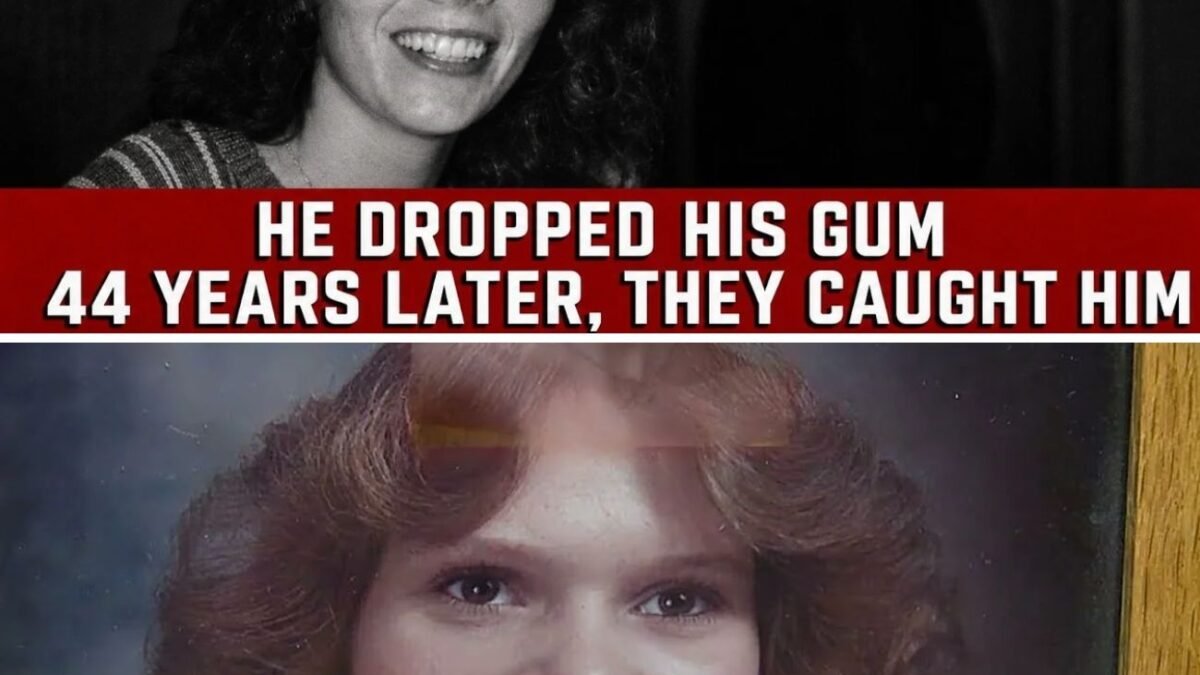
On the evening of January 15th, 1980, a young woman came running out of the treeine near Mount Hood Community College in Gresham, Oregon. She was waving her arms at passing cars on Northeast Kain Drive. There was blood on her face and mud on her clothes. She was screaming for help. Multiple drivers saw her.
They swerved around her. They hit the brakes so they wouldn’t run her over. One woman thought it was a college prank. Another man assumed a couple was having a fight. Nobody stopped. And then a man stepped out of the bushes, grabbed her by the arm, and pulled [music] her back into the darkness.
The next morning, students walking to class at Mount Hood Community College found the body of 19-year-old Barbara May Tucker in a grove of bushes between the road and a campus parking lot. She had been beaten to death. For 44 [music] years, nobody knew who killed her. Dozens of detectives worked the case.
DNA technology didn’t even exist when she died. And every single person who drove past her that night had to live with the same question. Could I have saved her? This is the story of how a piece of chewing gum spit onto the ground during a casual bike ride finally answered the question that had haunted Gresham, Oregon [music] for over four decades.
If you follow cold cases and the science that’s finally solving them, you’re going to want to stay for this one. Subscribe [music] to Cold Case Redemption so you don’t miss the next case we cover. Barbara May Tucker was born on February 25th, 1960 in Portland, Oregon. She was the youngest of eight children in the Tucker household, the baby of a big family in a city that was still decades away from the tech boom and the hipster reputation it would eventually develop.
Portland in the 1960s and 1970s was a workingclass town, a timber and shipping city, and the Tucker family was rooted in that world. Barbara grew up surrounded by older siblings, and the people who knew her said she had the kind of personality you’d expect from the youngest kid in a packed house. She was loud, she was funny, she was determined to be noticed.
Her family called her Barbie. Growing up in Portland, Barbie was the kind of kid who couldn’t sit still. She played basketball at Cleveland High School and she [music] was good at it. Standing 5′ 11 and 1/2 in tall, she was a natural on the court. She had the height, the reach, and the competitiveness to go further with it.
She was good enough to compete at the national level in basketball through her school’s athletic program. But sports weren’t the only thing she cared about. She was also a member of DECA, the Distributive Education Clubs of America, a national organization that prepared high school and college students for careers in marketing, finance, management, and entrepreneurship.
For Barbie, DECA wasn’t just an extracurricular. It was the beginning of a plan. She wanted to own her own business someday. She wanted to open a craft supply shop. That dream tells you something about who she was. This was a young woman who loved making things with her hands. She sewed her own clothes. She knitted. She crocheted.
She wrote poetry [music] and filled notebooks with it. She listened to music constantly. The kind of person who always had a song playing in the background. The people who knew her, her family, her friends, her classmates described her in a way that paints a very specific picture. goofy, ambitious, a free spirit, strong willed, spiritual, but not particularly religious, and incredibly hardworking.
She was the youngest of eight, and she carried herself like someone who had spent her entire childhood watching her older siblings figure out their lives and had decided she was going to do it her own way. After graduating from Cleveland High School in 1978, Barbie enrolled at Mount Hood Community College as a business major.
The campus sat on 212 acres of land in Gresham, Oregon, about 15 mi east of downtown Portland. The property had once been strawberry fields, bought through a public bond measure in the late 1960s and developed into a community college that served the eastern suburbs of the Portland metro area. By 1980, the campus was wellestablished, but still surrounded by the landscape that defined that part of Oregon.
Dense stands of Douglas fur and western red cedar. winding roads through hilly terrain, open parking lots that sat on the edges of wooded areas where the campus met the surrounding neighborhoods. Barbie moved into the ash mountain apartments, [music] a student housing complex near the campus, and picked up a job at a local department store to pay her way through school.
By January of 1980, she was a sophomore. She was 19 years old. She had a plan for her life. She had friends on campus and she was doing exactly what she was supposed to be doing. The last time her mother heard her voice was on the afternoon of January 15th. Barbie called home and mentioned she had an evening class that night.
If the class ended early, she said she might swing by a friend’s apartment for some ice cream on the way back to her place. Gresham in 1980 was a quiet town. The kind of place where a 19-year-old could walk across a community college campus at night without a second thought. The kind of place where a parent wouldn’t worry when their daughter mentioned walking to class in the evening.
The kind of place where people assumed nothing bad could happen in their neighborhood. That was about to change in a way that would grip the entire community for decades. If you believe victims like Barbara deserve to be remembered for who they were and not just how their stories ended, consider subscribing.
This channel exists to tell their full stories. Barbara Tucker was walking toward her evening class when everything went wrong. Sometime around 6:45 to 7:00 in the evening on January 15th, 1980, she came running out of a wooded slope on the west edge of the Mount Hood Community College campus. She burst onto Necain Drive, the two-lane road that ran along the perimeter of the campus and began waving her arms at oncoming traffic.
There was blood on her face, mud on her clothes. She was frantic. And she wasn’t alone. Multiple people driving down any Cane Drive that evening saw Barbara Tucker in the road. Their accounts collected by investigators in the days and weeks that followed paint a picture that is still difficult to process. More than four decades later, these were ordinary people, commuters, students, residents of the surrounding neighborhoods, driving home from work or heading to evening activities.
None of them expected to see a young woman covered in blood running into traffic. One woman told police she saw a female figure waving her arms and that the woman’s face was bloody. Another driver approaching from the opposite direction saw a man peeking through the bushes next to the college parking lot, watching the road as if waiting for something.
A third witness, a man, said he heard a woman screaming and saw two figures in the distance near the treeine. A fourth person reported seeing a woman standing on the roadside with mud on her pants, waving at passing cars. Drivers swerved to avoid hitting her. At least one vehicle came close enough that the driver had to slam on the brakes, but nobody pulled over.
Nobody rolled down their window. Nobody stopped to ask if she needed help. Nobody called the police. The assumptions people made in those few terrifying seconds would follow them for the rest of their lives. Some thought it was a college prank, the kind of thing bored students might do on a dark winter evening.
Others figured it was a couple having a fight, hitchhikers acting recklessly near the road, kids messing around in the dark. Every single one of those assumptions was wrong. And while those cars continued down the road, carrying their drivers away from the scene and into the rest of their ordinary evenings, a man emerged from the bushes along the tree line on the edge of the campus.
He grabbed Barbara Tucker by the arm and he pulled her back into the wooded area that separated Necain Drive from the campus parking lot. That was the last time anyone saw Barbara May Tucker alive. The next morning, January 16th, 1980, students arriving for their morning classes at Mount Hood Community College found her body.
She was lying in a grove of bushes between NECA Drive and one of the school’s parking lots. She was partially clothed. Her purse and her school books were scattered nearby, still on the ground where they had been left or dropped the night before. The Multma County Medical Examiner determined that Barbara Tucker had been assaulted and beaten to death.
The injuries to her head and face were severe. The news hit Gresham like a shock wave that rippled [music] outward through the entire Portland metro area. This was a community college campus in a quiet suburb. A 19-year-old business student, the youngest of eight kids, had been killed on her way to an evening class.
She had lived in the student apartments just a short walk from where her body was found. She was on campus in a place that was supposed to be safe. And the detail that made this case unlike anything Gresham had ever experienced, the one that ate at people and kept them awake at night was that Barbara Tucker had been seen. She had been running in the road covered in blood, screaming for help, waving her arms at passing vehicles.
And every single car drove past her. There is no record of any driver who passed Barbara Tucker on NEC Kain Drive that night ever being blamed or charged with anything. They had no legal obligation to stop. But the weight of what they witnessed and what they chose not to do in those few seconds became as much a part of the story as the crime itself.
For the people of Gresham, the question wasn’t just who killed Barbara Tucker. It was why nobody helped her when she was still alive. The Gresham Police Department launched an aggressive investigation in the days following Barbara Tucker’s murder. Officers canvased the neighborhoods around the Mount Hood Community College campus.
They knocked on doors. They interviewed students, faculty, and anyone who lived or worked near the area. They combed through the wooded area between Cane Drive and the parking lot. They collected physical evidence from the crime scene and sent it to the state forensics lab for analysis. Early in the investigation, detectives focused on the witnesses.
These were the people who had seen Barbara in the road that night, and investigators needed every detail those witnesses could provide. What did the man look like? How tall was he? What was he wearing? What kind of vehicle, if any, was nearby? The answers were frustratingly incomplete. The sightings had been brief.
[music] The road was dark. The witnesses were driving. Their attention divided between the road, the woman, and the shock of what they were seeing. Descriptions of the man varied. Some said he appeared to be about Barbara’s height or taller. Others gave less definitive accounts. By February of 1980, investigators had turned to an unusual technique for the era, forensic hypnosis.
The idea was to place the key witnesses under hypnosis, hoping to draw out details their conscious minds might have suppressed or forgotten, information buried by the trauma and confusion of the moment, a hair color, a face shape, the make of a car. The Oregonian newspaper documented this effort in an article published on February 12th, 1980 under the headline, “Hypnosis seeks clues in co-ed slaying probe.
” It was a sign of how seriously the department was taking the case and also a sign of how little they had to work with. Barbara Tucker was buried around January 22nd, 1980, one week after her death. The Tucker family was devastated and they were angry. Their youngest daughter had been murdered on a college campus while people drove past her. They wanted answers.
They expected answers. But despite the intensity of the initial investigation, no suspect was ever identified. [music] The witness descriptions were too vague to narrow the field. There were no surveillance cameras on the campus or along any Cane Drive. There were no DNA databases. The biological evidence collected during the autopsy was preserved, but the technology to analyze it at a genetic level simply did not exist in 1980.
The forensic tools that would eventually crack this case were [music] decades away from being invented. And so the case went cold. The years [music] started piling up. 1982, 1985, 1988. Each year, the Barbara Tucker file sat at the Gresham Police Department, occasionally picked up by a new detective, reviewed with fresh eyes, and put back down when those fresh eyes hit the same walls the previous detective had hit.
Over the course of 35 years, according to Detective Aaron Turnage, who would eventually take the case into his own hands, a rotating lineup of various detectives picked up the file at different points. Each one came in with energy and determination. Each one left without a suspect. The investigation wasn’t abandoned. It was just stuck.
Gresham’s oldest unsolved homicide had become the kind of case that new detectives inherited. Like a piece of furniture that nobody knew what to do with. It was always there. Everybody knew about it. Nobody could solve it. Throughout all of it, Barbara’s mother refused to let go. She kept a personal log, a running written record of every conversation she had with the police, every phone call, every update, every tip that came in and went nowhere.
Every theory that was raised, investigated, and ultimately dismissed. She called the Gresham Police Department with such regularity that the detectives on rotation knew her by first name. She was doing what any mother would do. She was trying to keep her daughter’s case alive when the system seemed ready to let it go quiet.
Albert Tucker, Barbara’s father, died in 1989, 9 years after his youngest daughter was murdered. He never learned who killed her. He never heard a suspect’s name. He never sat in a courtroom. Barbara’s mother died in 1995, 15 years after the murder. >> [music] >> She had spent the last years of her life maintaining that log, calling the police, holding on to hope that was getting thinner every year.
She died without knowing who killed her daughter. Neither parent ever heard the name Robert Arthur Plimpmpton. Neither parent ever saw a detective say, “We got him.” [music] Neither parent ever experienced the moment the Tucker family had been waiting for since January of 1980. After their mother’s death, Barbara’s sister, Susan per took over.
She became the family’s primary voice, the person who kept in contact with the police, who asked about updates, who pushed the department not to forget Barbie. It was a role she inherited from her mother, and she carried it the same way, with persistence and with grief. Years later, reflecting on those long decades of waiting, Susan would describe the experience with a kind of exhausted honesty that only comes from living through something like this.
We always had hope, she said. At one point, we thought he was dead. Maybe it would never be solved. I just wished it could have happened when the rest of my family was here, especially my parents. The hardest part of a cold case, the thing that people on the outside rarely understand, is the silence. There are no ticking clocks, no chases, no breakthrough montages.
There is just year after year of nothing. The phone doesn’t ring. The mail doesn’t bring news. The detective on the other end of the line is someone new again. And they have to be brought up to speed again. And they are optimistic again. And then they go quiet again. Susan per lived in that silence for decades.
She raised her own family during those years. She built her own life. But the unresolved murder of her youngest sister sat underneath all of it. A weight that never lifted and never got lighter. Holidays were complicated. Anniversaries of January 15th came and went. And every few months she would pick up the phone and call Gresham.
And the answer was always the same. No updates, no new leads, nothing. By the late 1990s, Gresham’s oldest unsolved homicide was, by all appearances, a case that would never be closed. 20 years had passed. Both of Barbara’s parents were dead. The witnesses who had seen her on the road that night were getting older.
The physical evidence was sitting in a storage facility, and the name of the man who killed Barbara Tucker remained completely unknown. That was about to change. In the year 2000, two decades after the murder, something shifted. It didn’t happen with a press conference or a breaking news alert. It happened quietly inside a forensic laboratory with a result that nobody outside the investigation would hear about for another 21 years.
The Oregon State Police Crime Lab received biological evidence that had been collected during Barbara Tucker’s 1980 autopsy and preserved in storage ever since. Using DNA analysis technology that had advanced enormously since the late 1980s, but was still in its relatively early stages of application to cold cases, forensic scientists at the lab successfully developed a DNA profile from the samples.
For the first time in 20 years, investigators had a genetic fingerprint of the man who had killed Barbara May Tucker. The profile was a string of genetic markers unique to one individual as distinctive as an actual fingerprint. If they could find the person it belonged to, they would have their killer. The profile was entered into COTUS, the combined DNA index system.
COTUS is the national DNA database maintained by the FBI and by 2000 it had grown to contain hundreds of thousands of profiles from convicted offenders. and crime scenes across the country. In theory, if Barbara Tucker’s killer had ever been arrested and had his DNA collected for a qualifying offense, the system would flag the match. Investigators waited for a hit.
It never came. The killer’s DNA was not in the system. There are several possible explanations for this. He may never have been convicted of a crime that required mandatory DNA collection. Oregon didn’t begin collecting DNA from all convicted felons until the mid 1990s. And even then, the database grew slowly.
If the killer’s offenses were minor or predated the collection requirements, his profile would simply not be there. Whatever the reason, the Kota search came back empty. And so, the DNA profile sat in the Oregon State Police Crime Lab waiting. It was real. It was specific. It could identify a murderer, but without a comparison sample, it was like having a key with no lock to try it in.
Five more years passed. 10 15. The profile just sat there. Around 2015, Detective Aaron Turnage of the Gresham Police Department picked up the Barbara Tucker cold case file. By this point, the case had passed through the hands of more detectives than anyone could easily count. Turnage was inheriting a case that was older than some of the officers in his department.
It had been cold for 35 years. Turnage along with Gresham police criminalist Deanna Gy who had been working the forensic side of the case for years began looking for new investigative avenues, fresh approaches, technologies that hadn’t existed the last time someone seriously worked the file. And Turnage did something else. He made a personal promise to Susan Pater, Barbara’s sister.
I promised her I was going to solve this case. Turnage later told reporters. If that means working around the clock, that’s what happens. It was the kind of promise that detectives sometimes make and sometimes keep. Turnage intended to keep it. And he arrived at exactly the right moment in the history of forensic science to have a real chance because a revolution was coming.
and it was about to reach Gresham, Oregon. This investigation is about to take a turn nobody expected. If Barbara’s story has your attention, drop a like so more people find this case. In April of 2018, investigators in Sacramento, California, announced the arrest of Joseph James D’Angelo, a 72-year-old former police officer who had terrorized communities across California for over a decade in the 1970s and 1980s.
The Golden State Killer, as he was known, was responsible for at least 13 murders and more than 50 sexual assaults. His case had been cold for decades. The method that caught him was something most Americans had never heard of. Investigators had uploaded crime scene DNA to a public genealogy database, the kind that ordinary people used to trace their family trees and discover distant relatives.
They found [music] distant cousins of the killer in the database. Then they built a family tree backward, generation by generation, until they narrowed the list of possible suspects to a single man. It was a [music] seismic moment in criminal justice. Investigative genetic genealogy, as the technique came to be called, went from an obscure academic concept to the single most effective cold case investigative method in American history almost overnight.
Within months, police departments across the country began submitting their oldest, coldest, unsolved cases for genealogy analysis. Cases that had been dead for 30, 40, 50 years, suddenly had a path forward. Susan Pater, Barbara Tucker’s sister, saw a 2020 television episode about this new technology.
She watched the segment and immediately recognized what it could mean for Barbara’s case. [music] The Gresham Police Department had a DNA profile sitting in a lab since the year 2000. If this genealogy technique worked the way the news segment described, that profile might finally be enough to put a name to the ghost who had killed her sister.
Susan reached out to a genetic genealogologist. She pushed for the technology to be applied to Barbara’s case. After 40 years of waiting, if there was a new tool available, she wanted it used. The Tucker family had already lost both parents to the weight. They were not going to sit back and let another breakthrough pass them by.
Using funding from a National Institute of Justice grant, the Gresham Police Department formally engaged Parabon Nanolabs, a Virginia based forensic intelligence company that had positioned itself at the forefront of the genetic genealogy revolution. The woman leading Parabon’s genealogy division was CC [music] Moore, a genetic genealogologist who had already helped identify suspects in dozens of cold cases across the country.
Moore was widely recognized as one of the pioneers of the field, having been involved in some of the most high-profile identifications since the Golden State Killer Breakthrough. Parabon’s team began their analysis by running the crime scene DNA through their proprietary snapshot system. Snapshot uses genetic markers to predict a suspect’s [music] physical appearance.
Things like eye color, hair color, skin tone, face shape, and freckling. The predictions are probabilistic, not exact. They narrow the field rather than providing a photograph. But in this case, one prediction jumped off the screen. The red hair prediction. CC Moore would later explain that Barbara Tucker’s case produced the most confident red hair prediction that Parabon scientists had ever recorded at that point in time.
The genetic markers associated with red hair were so strong in the crime scene DNA that there was an extremely high likelihood the killer had red hair. And in a genealogy investigation where you are trying to identify one person out of millions, a distinctive physical trait like that is gold. Moore’s process was methodical but painstaking.
She uploaded the crime scene DNA to genealogy databases and search for any profiles that shared genetic material with the unknown suspect. The initial match she found was faint. The person in the database shared less than 1% of their DNA with the crime scene sample. That meant the match was a distant relative, likely several generations removed.
a fourth cousin maybe or even further. But even a distant match is enough to start building a family tree. And that is where the real work of investigative genetic genealogy begins. The DNA gives you a connection to a distant relative. From there you have to reconstruct the family tree of that distant relative using traditional genealogical research, public records, census data, birth certificates, [music] death certificates, marriage records, immigration documents, historical databases.
You work backward generation by generation, [music] building out every branch of the family until you reach a point where two branches converge on the same ancestor. Then you work forward from that ancestor, tracing descendants down to the present day, looking for someone who fits the known profile of the suspect. Someone who was the right age in [music] the right place at the right time.
It is painstaking work. A single case can take weeks or months of tree building. And in Barbara Tucker’s case, Moan Moore was working with a very distant match, which meant the family tree she had to construct was enormous. But during that process, she discovered something that changed the entire trajectory of the investigation.
Old World War II draft registration cards filed by the federal government in the early 1940s documented the physical descriptions of men who registered for military service. Among the family lines Moore was investigating, she found draft cards that specifically described men with red hair.
Red hair is a recessive genetic trait. It does not appear in every generation, but when Moore found it documented in multiple men across one particular branch of the family tree, she knew she was looking at the right lineage. The red hair prediction from the DNA wasn’t just a novelty. It was a road map that helped because it made me focus on one particular line of the family and follow that red hair down, Moore explained.
And then I landed in Oregon. In March of 2021, 41 years after Barbara Tucker was beaten to death on the grounds of Mount Hood Community College, CC Moore identified a man named Robert Arthur Plimpmpton as the likely source of the DNA found on her body. Moore would later describe this case as one of the highlights of her career in genetic genealogy.
But there was a critical distinction that everyone involved understood from the beginning. Genealogy could generate an investigative lead. It could point detectives in the right direction. It could narrow the field from millions of potential suspects to one name, but it could not on its own produce the kind of forensic evidence that would survive the scrutiny of a courtroom.
For that, they needed a direct DNA comparison between the crime scene evidence and Robert Plimpmpton himself. They needed his DNA. And they needed to get it without him knowing they were watching. Gresham detectives now had a name, Robert Arthur Plimpmpton. They located him living in Troutdale, Oregon, a small city in eastern Molten Noma County, just a few miles east of Gresham.
Before making any move to approach him, investigators began building a background profile. Who was this man? Where did he live in 1980? What was his connection, if any, to Mount Hood Community College or to Barbara Tucker? What they found was deeply unsettling. Robert Arthur Plimpmpton was born in 1963. In January of 1980, when Barbara Tucker was killed, he was 16 years old.
He was a student at Reynolds High School, a public school in the Troutdale Gresham area. And he lived approximately half a mile from the Mount Hood Community College campus. Half a mile, a 10-minute walk through the residential streets and wooded areas that surrounded the school.
Close enough that the campus would have been part of his daily landscape. A place he could reach on foot without anyone thinking twice about a teenager walking through the neighborhood. There was no known connection between Plimpmpton and Tucker. Chief Deputy District Attorney Kristen Snowden would later confirm in court that there was no evidence the two had ever met.
No mutual friends, no shared classes, no relationship of any kind. Barbara’s family didn’t recognize the name when they were told. Her sister, Susan Pater, put it plainly. “We didn’t know all of Barbie’s friends,” [music] she said. said, “But it but it sounds like he was a complete stranger just out of the blue. A stranger. A 16-year-old who lived half a mile away.
The randomness of it was its own kind of horror. With the genealogical lead confirmed, Gresham detectives set up covert surveillance on Plimpmpton. They followed him through his daily routines. They watched where he went, what he did, how he moved through his day. They were patient. They were careful.
They needed one thing. A DNA sample that Plimpmpton had discarded voluntarily. Something he touched or left behind in a public space that detectives could legally collect and send to the crime lab for comparison. And then during a bike ride somewhere in the Troutdale area in 2021, Robert Arthur Plimpmpton spit a piece of chewing gum onto the ground.
He kept riding. He didn’t think about it. He didn’t look back. It was the kind of thing people do a hundred times without ever giving it a second thought. A small insignificant act. Behind him, a Gresham police detective picked the gum up off the ground and placed it into evidence. The chewing gum was submitted to the Oregon State Police Crime Lab.
Forensic scientists extracted a DNA profile from the saliva residue on the gum. They compared it to the profile that had been developed from Barbara Tucker’s autopsy evidence 21 years earlier in the year 2000. The same profile that had produced no match in Kotus. The same profile that had been sitting in a lab waiting for a name for two decades. It matched.
Detective Aaron Turnage described the result in clear unambiguous terms. A direct hit from our evidentiary standard to Robert Plimpmpton. The DNA from a piece of chewing gum spit onto a sidewalk during a bike ride by a man who had no idea he was being watched matched the DNA recovered from a 19-year-old murder victim four decades earlier.
After 41 years, the ghost had a name. After 41 years, the profile had a face, and the man who had killed Barbara May Tucker had been living freely, less than 20 m from the campus where she died for more than four decades. On June 8th, 2021, Gresham police detectives moved to arrest Robert Arthur Plimpmpton.
The location they chose was not random, and the symbolism of it was not lost on anyone involved. Detective Turnage would later tell reporters that Plimpmpton was taken into custody in front of Mount Hood Community College, literally several hundred feet from where he kidnapped her. 41 years after Barbara Tucker was beaten to death in a grove of bushes between a campus road and a school parking lot, the man who killed her was arrested at the very same college. He was 58 years old.
He had been a free man for his entire adult life. that ended on the same patch of ground where Barbara Tucker’s life had ended. Plimpmpton was booked at the Multma County Detention Center on charges of firstdegree murder, seconddegree murder, [music] and additional felony charges related to the assault on Tucker.
He pleaded not guilty at his arraignment on June 9th, 2021. Although Plimpmpton was 16 years old at the time of the murder, he was charged and tried as an adult under Oregon law. When Susan per learned the name of the man accused of killing her sister, she didn’t recognize it. Nobody in the Tucker family did.
The confirmation that Barbara’s murder was a random attack by a stranger, a teenager who lived nearby and who apparently had no prior connection to her whatsoever added a new dimension to a tragedy that was already almost unbearable. “We didn’t know all of Barbie’s friends,” Susan said. “But his but it sounds like he was a complete stranger just out of the blue.
For the first time in 41 years, there was a name on the other side of the equation. [music] There was a suspect in custody, and there was a DNA match strong enough to take to trial. The arrest of Robert Plimpmpton in 2021 raised an unavoidable question. If he was only 16 when he killed Barbara Tucker, what had he been doing for the 41 years between the murder and the arrest? [music] Had he lived a quiet, law-abiding life? Had the killing been a single catastrophic act by a troubled teenager never repeated? The answer was not reassuring. In
February of 1985, 5 years after Barbara Tucker’s murder, Robert Plimpmpton was convicted [music] of secondderee kidnapping in Portland. The circumstances of that crime bear a pattern that is deeply disturbing. When placed alongside what happened to Barbara Tucker, [music] a woman named Patricia Spangler was walking home from a grocery store on Southwest Powell Boulevard when Plimpmpton driving a truck offered her a ride. She accepted.
Once she was inside the vehicle, Plimpmpton slammed her into the footwell and tried to bind her arms with duct tape. Spangler fought back and managed to escape from the truck. She survived, but 5 years earlier, Barbara Tucker had not. Plimpmpton was sentenced to 30 months in prison for the kidnapping of Patricia Spangler. He served his time and was released.
In the years that followed, Plimpmpton accumulated a pattern of legal troubles that stretched across the next decade. Multiple driving under the influence charges, assault charges, restraining orders filed against him by women. And in 1997, he was accused of attempted sodomy and assault in an attack on another woman.
That 1997 case was eventually dismissed due to insufficient evidence. But the pattern was there. A history of violence against women that spanned decades. By the time detectives arrested him in 2021, Plimpmpton was 58 years old. He was married. He was a father. He was living in Troutdale in what looked from the outside like an unremarkable suburban life.
Neighbors who knew him would have seen a middle-aged man who went on bike rides and mowed his lawn. They would not have known what he had done on a dark evening in January of 1980. [music] At trial, Patricia Spangler, the woman who escaped from Plimpmpton’s truck in 1985, [music] was called to testify. She took the stand and told the court something that Barbara Tucker’s family had been thinking [music] since the arrest.
I could have easily been his next murder victim. And the Tucker family had to sit with the fact that no amount of justice could make easier [music] to process while they were grieving. While their mother was keeping her log and calling the police, while their father was dying without answers, while Susan Pater was spending decades pushing [music] to keep the case alive.
Robert Plimpmpton was raising children, building a household, going on bike rides, living the kind of ordinary life that Barbara Tucker never got the chance to live. This decision seemed small at the time. It wasn’t. What came next was a courtroom battle between cuttingedge DNA science and four decade old eyewitness [music] testimony.
And the outcome would determine whether Barbara Tucker’s case would finally be marked as closed. Robert Arthur Plimpmpton waved his right to a jury trial. He elected a bench trial instead, meaning that a single judge rather than a panel of 12 jurors would hear all the evidence and decide his guilt or innocence. The trial was held in Multma County Circuit Court before Judge Amy Bagio [music] and it ran for 3 weeks from February 26th to March 15th, 2024.
[music] The prosecution was led by Chief Deputy District Attorney Kirstston Snowden and Senior Deputy District Attorney Todd Jackson. Their case was built on the forensic evidence. The DNA profile developed from Barbara Tucker’s autopsy samples in the year 2000. The matching profile extracted from the piece of chewing gum Plimpmpton spit out during his bike ride in 2021.
The Oregon State Police Crime Lab analysis confirming the match. and the investigative genealogy work by Parabon Nanolabs and CC Moore that had originally pointed detectives toward Plimpmpton. On that last point, there was an important procedural detail. Nobody from Parabon testified at the trial.
No genealogologist took the stand. The genetic genealogy had served its purpose as an investigative lead, a way to generate a suspect’s name. The courtroom evidence was built entirely on conventional forensic DNA comparison. The gum matched the crime scene. The science was standard, wellestablished, and legally unimpeachable. [music] The defense led by Steven H and Jacob HS, a father and son legal team with a long track record in Oregon criminal defense, did not [music] concede.
They argued that there was, in their words, unmistakable, unavoidable, reasonable doubt. Their primary argument centered on the eyewitness testimony from 1980. Several of the witnesses who saw Barbara Tucker on the road that night had described the man with her as approximately her height or taller.
Barbara Tucker stood 5′ 11 1/2 in. Robert Plimpmpton, by contrast, was closer to 5’8. That is a difference of several inches. If the witnesses were correct about the man’s height, the defense argued, then Plimpmpton could not have been the person seen pulling Barbara back into the treeine. The defense also raised questions about gaps in the forensic investigation.
Investigators had never tested Barbara Tucker’s clothing for DNA. Only the autopsy samples had been analyzed. The houses asked why this additional avenue of testing had not been pursued and suggested that the failure to do so left room for doubt. For the Tucker family, the trial was an ordeal in its own right.
The 3-week proceeding was the first time the 1980 crime scene evidence had ever been presented publicly. photographs, forensic details, the full scope of what had been done to Barbara Tucker in those woods near the campus parking lot. The family sat in the courtroom and absorbed [music] details they had been shielded from for 44 years.
Robert Pater, Barbara’s brother-in-law, said the evidence was worse than a horror film. It is worth pausing here to understand what was really being argued in that courtroom. The defense was not claiming that Robert Plimpmpton was somewhere else. On the night of January 15th, 1980, they were not presenting an alibi. They were arguing that the DNA evidence alone, however strong, was not enough to overcome the doubt created by the physical description discrepancy.
In other words, the defense was betting that a judge would find it more plausible that the witnesses were right about the man’s height than that the DNA was right about the man’s identity. It was a calculated gamble and it put Judge Bagio in a position that cold case judges increasingly face in the era of genetic forensics.
How much weight should be given to eyewitness testimony collected in chaotic conditions on a dark road during a few seconds of shock and confusion more than four decades ago versus DNA evidence processed with modern forensic methods and confirmed through two independent samples collected 21 years apart. On March 15th, 2024, Judge Amy Bagio delivered her verdict.
Guilty, one count of firstdegree murder, four counts of seconddegree murder under different legal theories. Plimpmpton was not convicted on charges of sexual assault. Prosecutors were unable to prove beyond a reasonable doubt that the assault occurred while Barbara Tucker was still alive. But on the murder itself, the judge’s words left no room for interpretation.
To be clear, Judge Bagio said from the bench, this court [music] has zero doubt whatsoever that Robert Plimpmpton beat Barbara Tucker in her head and face until she died. He did. Zero doubt. After 44 years, a judge had spoken the words the Tucker family had waited their entire adult lives to hear. Sentencing was originally scheduled for June 21st, 2024.
It was continued to October 3rd. When the day finally came, it was Judge Kelly Sky, not Judge Bagio, who presided over the hearing. The defense made one final push. Plimpmpton’s attorneys asked for parole eligibility after 20 years, the mandatory minimum under the 1979 sentencing guidelines that applied to the case.
They cited the transiencece of youth, noting that Plimpmpton had been only 16 at the time of the murder. They pointed to his relatively clean record since the late 1990s. In their view, decades of living without major legal trouble should count for something when determining how long he should serve before being eligible for parole.
Judge Sky disagreed. The sentence was life in prison with a minimum of 40 years before Plimpmpton would be eligible to appear before a parole board. That was double the mandatory minimum required under the 1979 sentencing guideline. Judge Sky made the deliberate decision to go beyond what the law required, doubling the minimum based on the severity of the crime and the circumstances of the case.
Plimpmpton was 61 years old at the time of sentencing. A 40-year minimum means he would be over 100 before he could even file for a parole hearing. In practical terms, Robert Arthur Plimpmpton will die in prison. He did not speak at the sentencing [music] hearing. He sat in the courtroom and said nothing.
When a member of Barbara Tucker’s family asked him to turn around and face them, to look at the people he had spent 44 years hiding from, he only removed his glasses and rubbed his brow. He did not turn around. He would not look at them. The defense signaled an appeal immediately after the hearing. We will appeal, the Hooses told reporters, and we are confident that his convictions will be overturned.
As of this recording, no appeal has resulted in his conviction being overturned. Plimpmpton was immediately transferred to the Oregon Department of Corrections to begin serving his sentence. For the Tucker family, the sentencing was the final act of a story that had consumed the majority of their lives. But the relief, if that word even applies to a situation like this, was complicated.
40 years of silence. 44 years between the crime and the sentence. Two parents who died waiting. Decades spent wondering if the case would ever be solved or if the killer was even still alive. The arithmetic of cold case justice is never clean. You can convict the killer. You can lock him away for the rest of his life.
[music] You can close the file and mark the case as solved. But you cannot give a family back the 44 years they spent waiting. You cannot bring [music] back the parents who died without answers. You cannot undo the decades of grief and uncertainty that shaped the lives of every person [music] Barbara Tucker left behind. Justice arrived, but it arrived 44 years late.
And the Tucker family understood better than anyone that late justice is still [music] justice. But it is not the same as timely justice. It never can be. The Tucker family waited 44 [music] years for the word guilty. That is a number that is easy to say and almost impossible to truly [music] understand. When Barbara was killed in January of 1980, her siblings were young.
By the time Robert Plimpmpton was convicted in March of 2024, they had spent more of their lives waiting for justice than they had spent living before the murder happened. Susan Pater, who had taken over her mother’s role as the family’s voice decades earlier, spoke after the verdict with the kind of quiet exhaustion that comes from carrying something for that long.
“Just not giving up,” she said. “We always had hope. At one point, we thought he was dead. Maybe it would never be solved. I just wished it could have happened when the rest of my family was here, especially my parents. [music] Her sister, Alice Juan, another of Barbara’s surviving siblings, spoke after the sentencing hearing.
I don’t think he’s had any remorse, [music] any regret, any conscience. She said, “I never thought we’d see this day.” Robert Pater, Barbara’s brother-in-law, described the crime with a single word: sadistic. In the days following the conviction, the Tucker the Tucker family brought sweet treats to the Gresham Police Department.
Cookies and pastries delivered to the detectives who had worked the case. It was a small human gesture, the kind of thing that doesn’t make it into legal records or news articles, but says everything about the relationship between a family and the people who kept their promise. And in return, the department gave the family something back.
One of Barbara’s earrings, which had been collected as evidence from the crime scene in 1980 and held in storage ever since, [music] was finally returned to the Tucker family. For 44 years, that earring had sat in an evidence locker at the Gresham Police Department. Now, it was going home. Detective Aaron Turnage kept his promise, the one he made to Susan Pater years earlier, that he would solve this case no matter what it took.
He didn’t do it alone. Criminalist Deanna Graci worked the forensic angle for years. CeCe Moore and the Parabon Nanolabs team built the genetic family tree that led to Plimpmpton’s name. The Oregon State Police Crime Lab developed the DNA profile that connected the gum to the crime scene. But Turnage was the detective who took personal ownership of the case, who made the commitment, and who followed through until the handcuffs were on.
The broader significance of Barbara Tucker’s case extends well beyond Gresham, Oregon. Her case is one of a growing number of decades old murders being solved through investigative genetic genealogy, the same technology that caught the Golden State Killer in 2018. Across the country, cold case units are submitting old evidence for genealogical analysis.
And families who had given up hope are receiving phone calls they never expected to get. The science that didn’t exist when Barbara died, that wasn’t ready when the DNA profile was built in 2000, that was still experimental when it caught D’Angelo in 2018, has now matured into a standard investigative tool, and it is reaching cases that are 40, 50, even [music] 60 years old.
And then there are the witnesses, the people who drove past Barbara Tucker on Northeast Kain Drive on the evening of January 15th, 1980. The ones who saw her running into the road bloody and frantic, waving her arms and screaming for help. The ones who assumed it was a prank or a fight [music] or kids being reckless and kept driving.
Those people have lived with that moment for more than 40 years. Whether they ever learned the full story of what happened after they drove away, whether they followed the investigation over the decades, whether they watched the news in 2024 and heard the name Robert Arthur Plimpmpton and the word guilty, nobody knows.
But the question they carried, the one that has no good answer, could I have saved her, [music] is now joined by at least one piece of resolution. The man who killed Barbara Tucker has been identified, tried, convicted, and sentenced. The case is closed. The question itself, for the people who were there that night, may [clears throat] never be.
Barbara May Tucker was the youngest of eight children. She was a basketball player who stood nearly 6 feet tall. She was a business student who wanted to open her own craft supply shop. She was a girl who knitted and crocheted and wrote poetry and notebooks that she carried with her. She was 19 years old. She was walking to class and she never came back.
For 44 years, her case sat in a file at the Gresham Police Department. For 44 years, her family waited. And in the end, the piece of evidence that brought everything together was a piece of chewing gum spit onto the ground by a man who had no idea that the science which would convict him had already been set in motion two decades earlier.
A piece of gum, a DNA match, and a family that refused to let the world forget their Barbie. 44 years. A detective who kept his promise. A genetic genealogologist who followed red hair through a family tree. And a piece of chewing gum that ended four decades of silence. Barbara Tucker didn’t get the life she was supposed to have.
She didn’t get to open that craft shop. She didn’t get to grow old. She didn’t get to see what she could have become. But she got something that thousands of cold case victims across this country never receive. her name spoken in a courtroom, a judge who said she had zero doubt, and the word guilty attached to the man who took her from her family.
Every case on this channel was once considered unsolvable. If you want to be here when the next one gets its answer, subscribe to Cold Case Redemption. We will see you in the next one.
Credit by: News