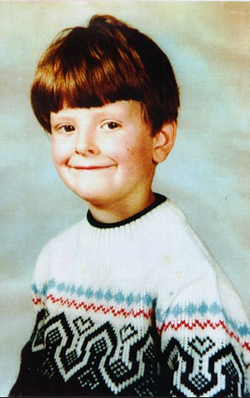
The Disappearance of Mark Anthony Tildesley
Wokingham, Berkshire, England — June 1, 1984
It was supposed to be an ordinary evening during the school holiday.
Seven-year-old Mark Anthony Tildesley was excited about going to the travelling funfair that had arrived in Wokingham. The rides, the lights and especially the dodgems were exactly the kind of excitement a child his age would look forward to.
Instead, Mark would leave home that evening and never return.
What followed was one of the largest searches Wokingham had ever seen. Police officers, soldiers, tracker dogs and members of the public searched for the missing boy. His photograph appeared across Britain, and his disappearance was eventually featured on Crimewatch UK.
But despite thousands of leads and years of investigation, Mark’s remains have never been recovered.
And decades later, questions still surround exactly where his body was taken.
A Young Boy in Wokingham
Mark Anthony Tildesley was born on 31 August 1976 in Berkshire. He lived with his parents, John and Lavinia, at Rose Court in Wokingham.
He was considerably younger than his two older siblings, who had already left the family home. Mark attended Palmer C of E Junior School and was in Year 3.
By the spring of 1984, Mark was seven years old and looking forward to the school holiday.
His school closed for the spring half-term on 25 May.
Around the same time, the Frank Ayers Fun Fair arrived at Carnival Field near Wellington Road.
For Mark, the fair was a major attraction.
There was only one problem.
He didn’t have much spending money.
Mark reportedly received just 30 pence in pocket money each week. To earn a little extra, he would return abandoned shopping trolleys to a Tesco store in Denmark Street and collect the small deposits associated with them.
He was determined to have enough money to enjoy the fair.
A Stranger With 50 Pence
On the afternoon of 1 June 1984, Mark encountered a man outside a sweet shop on Denmark Street.
The man gave him a 50p coin to buy sweets.
But the encounter didn’t end there.
According to the account later given to investigators, the man told Mark that he would also be at the funfair that evening and would pay for him to ride the dodgems—Mark’s favourite attraction.
It was a seemingly harmless promise to a young child.
That evening, it would become a crucial part of the investigation.
Mark Leaves Home
Shortly after 5:30 p.m., Mark left his home on his bicycle.
The fairground was only about half a mile away, and it was expected to open at 6 p.m.
Mark told his parents that he would be home by 7:30 p.m.
While travelling toward the fair, he encountered two friends. They intended to return home before going to the fair later.
Mark continued alone.
That meeting would become the last confirmed sighting of him by people who personally knew him.
7:30 P.M. — Mark Doesn’t Come Home
The promised return time came and went.
Mark was not home.
At approximately 8 p.m., his parents went to the fairground themselves to look for him.
There, they found his bicycle chained to railings near the entrance.
Mark was nowhere to be found.
His parents returned home, and at 10 p.m., his mother reported him missing to police.
A search that would continue for years had begun.
An Enormous Search Begins
Thames Valley Police launched an extensive operation throughout Wokingham.
Officers searched the fairground and surrounding areas. A helicopter was used, nearby waterways were examined, and loudspeaker appeals were made.
Special heat-detection equipment capable of assisting in the search for human remains was obtained from the Metropolitan Police.
Every worker and stall-holder at the fair was questioned.
Police also conducted door-to-door enquiries throughout the town, covering 29 streets and hundreds of homes, shops and businesses.
The search soon expanded beyond the immediate area.
On 9 and 10 June, fifteen police officers and two tracker dogs were joined by around 100 British Army soldiers from the Royal Electrical and Mechanical Engineers training battalion at Arborfield Garrison.
They searched an extensive area south of Wokingham.
Nothing was found.
Two weeks after Mark disappeared, Detective Superintendent Roger Nicklin acknowledged publicly that investigators still had no clear explanation for what had happened to the boy.
Witnesses Report a Disturbing Sighting
Then came information that changed the direction of the investigation.
Several witnesses said they had seen a boy matching Mark’s description near the fairground that evening.
According to these accounts, the child appeared to be struggling as a stooping man forcibly led him away from the fairground sometime between approximately 7 and 8 p.m.
Other reported sightings placed a boy resembling Mark around Langborough Road.
The police now had reason to consider the possibility that Mark had not simply wandered away.
He may have been taken.
Britain Searches for Mark
Mark’s disappearance quickly became a national story.
A poster campaign was launched across the country, including displays at police stations.
His case received widespread media attention and was featured on the premiere episode of the BBC’s Crimewatch UK on 7 June 1984.
The public responded in huge numbers.
Hundreds of people contacted police following the first broadcast.
Investigators also created a reconstruction using another local seven-year-old boy dressed in clothing similar to what Mark had been wearing.
The following year, as the Frank Ayers Fun Fair returned to Wokingham, police filmed another reconstruction showing locations connected to Mark’s disappearance.
The programme aired the reconstruction on Crimewatch UK on 13 June 1985.
More than 1,000 calls reportedly came in after that broadcast.
In total, police received information from more than 1,200 people, producing approximately 2,500 potential leads.
Yet none provided the answer Mark’s family desperately needed.
THE INVESTIGATION
A Case That Quickly Outgrew Wokingham
The original investigation was led by Detective Constable Geoff Gilbert, who already knew Mark’s family through his mother’s connection with Wokingham police station.
The local police force, however, was not prepared for an investigation of this scale.
Only four officers were initially assigned to the case, partly because Thames Valley Police was already heavily committed elsewhere during the miners’ strike.
Wokingham Police Station was too small to accommodate the growing investigation.
The attic storeroom became the incident office.
A temporary office was established at the fairground.
A nearby Baptist church was also used as a meeting location.
Within six weeks, the operation had become so large that the incident office had to be moved to Sulhamstead, near Reading.
Early Suspects
Investigators initially examined people close to Mark and those connected with the fair.
Mark’s older brother Christopher had argued with him earlier that day and was briefly treated as a suspect. Investigators eventually ruled him out.
Another man connected with the funfair was arrested after anonymous callers identified him as someone they believed was responsible.
He confessed to abducting Mark and claimed that he had raped and killed him in his nearby caravan.
But his account repeatedly changed.
Investigators ultimately concluded that his confession could not be relied upon.
Then another name entered the investigation.
Sidney Cooke.
Sidney Cooke
In August 1984, Metropolitan Police officers interviewed Cooke at his London home.
A fellow fairground worker had reportedly raised concerns about Cooke’s previous behaviour around young boys.
Investigators asked him whether he had been in Wokingham on the night Mark disappeared.
Cooke claimed that he had been working at another fair in London. The fair’s owner supported his account.
As a result, Cooke was not treated as the person responsible for Mark’s disappearance at that stage.
The investigation gradually lost momentum.
By October 1984, Thames Valley Police began winding down the original operation.
But Mark’s case was not forgotten.
OPERATION ORCHID
In 1989, the Metropolitan Police established Operation Orchid, an investigation examining the disappearances of children.
The inquiry would eventually bring Mark’s case back into focus.
In December 1990, investigators interviewed convicted child sex offender Leslie Bailey, who was already connected to other child murders.
Police had obtained a handwritten map and a letter connected to Bailey. The material pointed investigators toward information concerning Mark’s disappearance.
During questioning, Bailey eventually provided a confession.
He claimed that Mark had been abducted by a group of men associated with Sidney Cooke.
The group had been referred to by police as the “Dirty Dozen.”
Bailey’s account was devastating.
According to his confession, Mark had been taken from the fairground, transported to a caravan and murdered.
The disturbing account also appeared to provide an explanation for the mysterious “stooping man” witnesses had reported seeing in 1984.
Investigators believed the description referred to Cooke.
“MARK’S PARTY”
Bailey told investigators that he had been asked to drive from Hackney to Wokingham by Leonard “Lennie” Smith.
The reason for the journey was supposedly a party at a caravan belonging to Cooke near the fairground.
According to Bailey’s account, Smith went into the fairground and later returned with a young boy.
That boy was Mark.
Bailey said Mark was unwilling to go with them and had to be physically forced into the vehicle.
From there, they travelled toward Cooke’s caravan at a location known as The Moors, near Evendons Lane.
Another man, a relative of Bailey referred to during the investigation as “Odd Bod,” was allegedly present.
What happened afterward formed the central allegation of the later investigation.
Bailey said Mark was sexually assaulted and murdered.
He also claimed that after the killing, Cooke would take responsibility for disposing of the child’s body.
THE SEARCH FOR MARK’S REMAINS
Solving the circumstances surrounding Mark’s disappearance did not answer the most painful question for his family:
Where was Mark?
Bailey said he did not know where Cooke had buried him.
Investigators searched The Moors in March 1991, following Bailey’s confession.
They found nothing.
Cooke was believed to know where Mark’s body had been taken, but he never provided the location.
Years later, other possible search locations were considered.
In 2012, a fragment of human skull discovered near Evendons Lane was examined, but it was determined not to belong to Mark.
His remains have never been recovered.
Police initially believed he may have been buried within a short distance of the fairground. Later accounts indicated that investigators believed he could have been placed in a shallow grave somewhere on abandoned farmland.
For Mark’s family, there was still no grave to visit and no final certainty about what had happened to his body.
THE PEOPLE LINKED TO THE CASE
Sidney Cooke
Cooke never admitted involvement in Mark’s murder.
One significant piece of evidence was a key ring found in his Jaguar after the vehicle was repossessed in 1985. It was reported to be identical to one belonging to Mark.
Despite this and the information supplied by Bailey, Cooke was never charged with Mark’s murder.
The Crown Prosecution Service concluded that the available evidence was insufficient to secure a conviction.
In later years, former investigators continued to question whether more could have been done to prosecute Cooke.
Leslie Bailey
Bailey eventually faced legal proceedings connected with Mark’s death.
On 18 October 1991, he was charged with Mark’s murder, along with persons unknown.
However, the case did not proceed to a murder conviction.
On 22 October 1992, Bailey pleaded guilty to the lesser charge of manslaughter as well as a sexual offence.
He received two life sentences in December of that year.
Bailey was later murdered in prison on 7 October 1993, when fellow inmates strangled him using a ligature.
His death meant that one of the central figures in the investigation could never provide further answers about what happened to Mark or where his body was taken.
Leonard “Lennie” Smith
Smith was also named in Bailey’s account.
He never admitted involvement in Mark’s killing, and no charges were brought against him in connection with the case because prosecutors considered Bailey’s evidence insufficient for a successful prosecution.
Smith died in prison in 2006.
“Odd Bod”
Another man mentioned by Bailey was his relative, known throughout the investigation as “Odd Bod.”
Because of his reported mental age, authorities determined that he could not be prosecuted in connection with the killing.
His identity was not publicly disclosed.
A CASE WITHOUT A BODY
Although the investigation eventually established a detailed account of what investigators believed happened to Mark, one crucial piece of evidence remained missing.
Mark himself.
Thames Valley Police received recognition for the sustained investigation that ultimately uncovered information about his death.
But officers also acknowledged that the case remained incomplete because Mark’s body had never been recovered.
In 2007, Thames Valley Police created a Dedicated Review Team to examine unresolved murders and serious sexual offences dating back decades. Mark’s case was among those reviewed.
No remains were found.
No new evidence produced the definitive answer his family had been waiting for.
MARK’S FINAL RESTING PLACE REMAINS UNKNOWN
In 2015, former Operation Orchid investigator Roger Stoodley publicly raised concerns about how the case had been handled and argued that there had been enough evidence to prosecute Cooke.
Those claims reflected the continuing dispute surrounding the case and the decision not to charge Cooke.
Meanwhile, investigators continued to face the same fundamental problem.
They knew far more about Mark’s disappearance than they had known in 1984.
But they still did not know where he was.
In 2019, Mark’s family made another public appeal to Cooke, asking him to finally reveal the location of the child’s remains.
It was a plea that came more than three decades after Mark had disappeared.
A FAMILY THAT NEVER STOPPED WAITING
For Mark’s parents, the disappearance never became a closed chapter.
His bedroom was kept as it had been when he vanished for many years.
The room remained a physical reminder of the seven-year-old who had left home expecting to spend an evening at the fair.
But he never came back.
A memorial bench was eventually placed near the fairground entrance, at the location associated with Mark’s last known movements.
A memorial service was held on 30 January 1993 at Rose Street Methodist Church in Wokingham.
A headstone was also placed at the Free Church Burial Ground.
These memorials gave Mark a permanent place within the community where he had grown up.
But they could never replace the one thing his family wanted most.
His remains.
MORE THAN FOUR DECADES WITHOUT ANSWERS
Mark Tildesley left his home on a summer evening in 1984 to visit a funfair less than a mile away.
He never returned.
His disappearance triggered an enormous search, national publicity and one of Britain’s most enduring missing-child investigations.
Years later, investigators uncovered evidence pointing toward a group of men and obtained a confession from Leslie Bailey. Yet the legal outcome remained incomplete, and Mark’s body was never recovered.
Today, the case remains marked by an unanswered question:
Where was Mark Tildesley buried?
For his family, that question has remained unanswered for more than four decades.
The fairground where seven-year-old Mark disappeared has changed with time.
Wokingham has changed too.
But the memory of the little boy who left home on his bicycle that evening has never disappeared.
And somewhere, the location of his final resting place may still be waiting to be found.
This story is based on publicly available information and reported facts. It has been independently written and presented for informational purposes. Images, if any, belong to their respective owners.